What is content strategy? A Clear Framework to Grow Your Channel
Think of a content strategy as the blueprint for your YouTube channel. It’s the high-level plan that dictates why you're making videos, who you're making them for, and how they'll actually help you reach your goals. It’s what separates the creators who build sustainable, growing channels from those who just throw videos at the wall and hope something sticks.
With a solid strategy, every single video you upload has a clear purpose beyond just chasing views.
What Is a YouTube Content Strategy, Really?
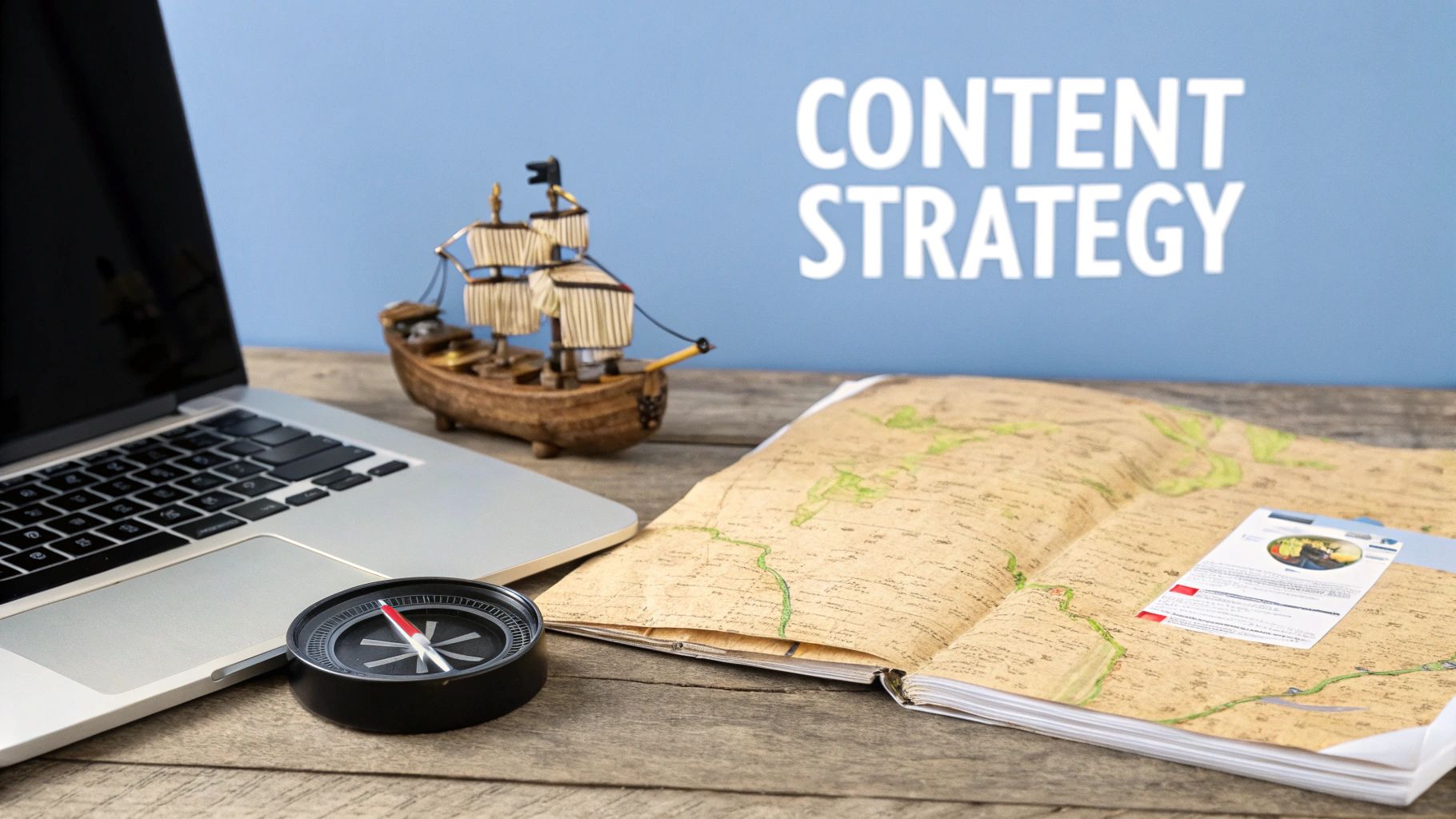
Picture your YouTube channel as a ship about to set sail. Without a map, a compass, or even a destination in mind, you’re simply drifting. You might end up somewhere interesting by chance, but you're more likely to get lost at sea.
A good content strategy is your map, your compass, and your destination all rolled into one. It gives you the direction you need to navigate the vast, often choppy waters of online video, ensuring you don't waste precious time and energy on content that leads nowhere.
Fundamentally, this plan forces you to answer the most important questions about your channel:
- Who are you trying to reach? What do they care about? What problems can you solve for them?
- What makes you different? In a sea of creators, why should someone choose to watch your videos?
- How does this all connect to your goals? How does each video push you closer to more subscribers, a stronger community, or even a sustainable income?
At its heart, a content strategy is the bridge between your channel’s mission and what your audience truly needs. It turns your passion and creative sparks into a repeatable system for growth.
The Five Pillars of Your Strategy
To build a channel that lasts, your strategy needs a solid foundation. This foundation rests on five core pillars that work together to create a cohesive, effective plan. Think of them as the essential ingredients in a recipe for consistently brilliant content.
Nailing each of these pillars helps guide every decision you make, from brainstorming video ideas all the way through to promoting your finished work.
This structured approach is more important than ever. In the UK alone, the social media advertising market is projected to reach a staggering £9.95 billion by 2025. For you as a creator, this means a huge opportunity exists if you can align your videos with what people are genuinely interested in.
Let’s take a look at the five pillars that will hold your strategy together.
The Five Pillars of a YouTube Content Strategy
Here’s a quick-glance summary of the essential pillars you need to build a successful YouTube content strategy.
| Pillar | What It Answers | Why It Matters for Your Channel |
|---|---|---|
| Audience & Niche | "Who am I creating for?" | Defines your target viewer, ensuring your content is relevant and resonates with a specific group. |
| Channel Goals | "What am I trying to achieve?" | Sets clear, measurable objectives like subscriber growth or lead generation to track your success. |
| Content Pillars | "What topics will I cover?" | Establishes 3-5 core themes for your channel, creating consistency and brand identity. |
| Distribution Plan | "How will people find my content?" | Outlines how you will promote your videos beyond YouTube, such as on social media or in newsletters. |
| Measurement & KPIs | "How will I know if it's working?" | Identifies key metrics like watch time and CTR to analyse performance and refine your strategy. |
By building out each of these five areas, you create a comprehensive roadmap that not only keeps you on track but also helps you adapt and grow intelligently over time.
Why a Content Strategy Is Your Best Growth Hack
So many creators get caught in the ‘spray and pray’ cycle. You get a flash of inspiration, chase a fleeting trend, hit publish, and just hope one video magically takes off. It’s not just exhausting; it's a fast-track to burnout and a channel that’s going nowhere.
A proper content strategy is the perfect antidote. It turns your channel from a lottery ticket into a reliable growth engine. Instead of just guessing what might resonate, you're building a deliberate system where every single video has a clear, strategic purpose.
This is the fundamental shift that separates the channels that truly thrive from those that just about survive.
Build Sustainable Consistency
On YouTube, consistency is king. The algorithm loves it, and your audience craves it. But it’s not just about posting every Tuesday. It’s about delivering a consistent experience.
Your strategy is what defines that experience. It lays down clear guidelines for your topics, your formats, and your tone of voice. This makes coming up with fresh ideas infinitely easier and helps you keep the momentum going. You're never staring at a blank page when you know your core content pillars.
Practical Example: Take a channel like Yoga with Adriene. Her strategy ensures consistency in tone (calm, welcoming), format (full-length yoga practices), and schedule (regular uploads for her 30-day challenges). Her audience knows exactly what to expect, which builds immense trust and keeps them coming back.
Deepen Your Audience Connection
Random videos attract a random audience. A strategic approach, however, builds a real community. When you define exactly who your content is for, you can craft videos that speak directly to their biggest problems, their passions, and their questions.
This targeted content fosters a much deeper connection. Your audience feels seen and understood because you’re consistently showing up with solutions or entertainment that feels like it was made just for them. This is how you build a loyal tribe that comments, shares, buys your merch, and becomes your biggest advocate.
Just look at UK tech creator Mrwhosetheboss. His strategy is brilliantly simple: high-quality, easy-to-understand tech reviews and comparisons. His reliable formats and clear value have built a massive, loyal community that hangs on his every word. It's proof that a focused strategy builds an incredibly powerful brand. To learn more about getting your videos in front of the right people, check out our complete guide on how to promote videos on YouTube.
Achieve Measurable and Predictable Growth
At the end of the day, a strategy is all about hitting your goals. Without one, any growth you see is just a happy accident. With one, it becomes intentional. A written-down plan lets you set specific key performance indicators (KPIs) and actually track your progress.
This data-driven mindset takes the guesswork out of creating. You can clearly see what’s working and what’s falling flat, letting you double down on successful formats and move away from topics that don’t connect. You start treating your channel like a business, and you get real business results.
The proof is in the numbers. Across the UK, businesses with a documented content plan achieve 33% higher returns than those without one. That stat is hugely relevant for creators. It shows how tools like Vidito, which help you validate ideas with real search data, reflect the thinking of the 81% of marketers who see content as a core business strategy. Your channel is a business, and a content strategy is your plan for success. You can dive into more of these UK content marketing statistics to see the full picture.
How to Build Your YouTube Strategy From Scratch
Alright, enough with the theory. It's time to roll up our sleeves and actually build this thing.
Creating a content strategy isn't some abstract, academic exercise; it's a practical, step-by-step process that brings clarity and purpose to your channel. Think of it like building a house. You wouldn't just start throwing up walls without a solid blueprint, right? Your strategy is that blueprint.
This framework breaks it all down into five straightforward stages. Each one builds on the last, taking you from your big-picture vision to the nitty-gritty details of creating and sharing your videos.
Step 1: Define Your Mission and Goals
Before you ever think about what videos to make, you have to be crystal clear on why you're making them. Your mission is the heart of your channel. Are you here to teach, to make people laugh, to inspire them to take action?
Once your mission is set, you need real, measurable goals. Vague wishes like "I want more subscribers" are useless because you can't track them effectively. Get specific.
- Growth: I want to hit 1,000 subscribers and 4,000 watch hours in the next six months.
- Community: I want to see an average of 50 comments per video within its first week.
- Business: I want to drive 100 clicks a month from my videos to my online shop.
These goals become your North Star, guiding every decision you make for your channel.
Step 2: Identify Your Ideal Viewer
Here’s a hard truth: you can't create content for everyone. The most powerful strategies are laser-focused on a very specific audience. So, who are you talking to? What keeps them up at night? What are their biggest questions, frustrations, and passions?
Sketch out a simple viewer persona. For instance, if you run a channel about personal finance for young professionals in the UK, your ideal viewer might be "Fiscally-Minded Fiona."
- Who is she? A 28-year-old marketing manager living in Manchester.
- What are her problems? She’s drowning in budgeting apps, she’s terrified of investing but wants to start, and she’s trying to save for a house deposit.
- What content does she need? Videos like "How to Actually Stick to a Budget in Notion" or "A No-Nonsense Guide to ISAs for UK Millennials."
When you know "Fiona" this well, you can create videos that feel like they were made just for her. That's how you build a real connection.
Step 3: Establish Your Core Content Pillars
Your content pillars are the 3-5 core topics your channel will own. Think of them as the main sections of a bookshop; they give your channel structure and tell new viewers exactly what they can expect. They also stop you from chasing random video ideas that don't fit your brand.
For our UK personal finance channel, the pillars might look like this:
- Smart Budgeting & Saving
- Beginner-Friendly Investing (UK)
- Getting on the Property Ladder
- Boosting Your Income
From now on, every video idea must fit under one of these pillars. No exceptions. This discipline builds consistency and quickly establishes you as the go-to expert in your niche.
Step 4: Develop a Content and Distribution Plan
This is where you figure out your video formats and, just as importantly, how you’ll get them in front of your ideal viewer. Will you focus on tutorials, vlogs, interviews, or reviews? Mixing it up a bit can keep your channel feeling fresh.
But your job isn't done when you hit "publish." That’s only half the battle. Your distribution plan needs to answer a few key questions:
- How will I promote videos elsewhere? Will you chop up your main video into short clips for TikTok and Reels?
- Will I use an email newsletter? An email list is a direct line to your biggest fans, bypassing the YouTube algorithm.
- Where do my viewers hang out online? Could you share your expertise in relevant Reddit or Facebook groups without being spammy?
A solid plan also means creating a repeatable workflow. Part of protecting your workflow is protecting your channel itself. To keep your channel healthy and growing, you should understand how to avoid copyright strikes on YouTube.
Step 5: Create Your Editorial Calendar
Your editorial calendar is where your strategy comes to life. It’s your schedule for what gets published, and when. This is the secret to staying consistent without burning out.
You don't need complicated software. A simple spreadsheet or a free tool like Trello works great. For each video, your calendar should track the essentials:
- Publish Date
- Video Topic/Title
- Which Content Pillar it falls under
- Production Status (e.g., Scripting, Filming, Editing, Done)
- Main Call-to-Action (e.g., Subscribe, Watch Next Video)
A well-kept calendar is what turns your grand vision into a reliable flow of great content. If you want to dive deeper, we have a whole guide on how to create a content calendar.
The flowchart below neatly sums up how all these pieces work together.
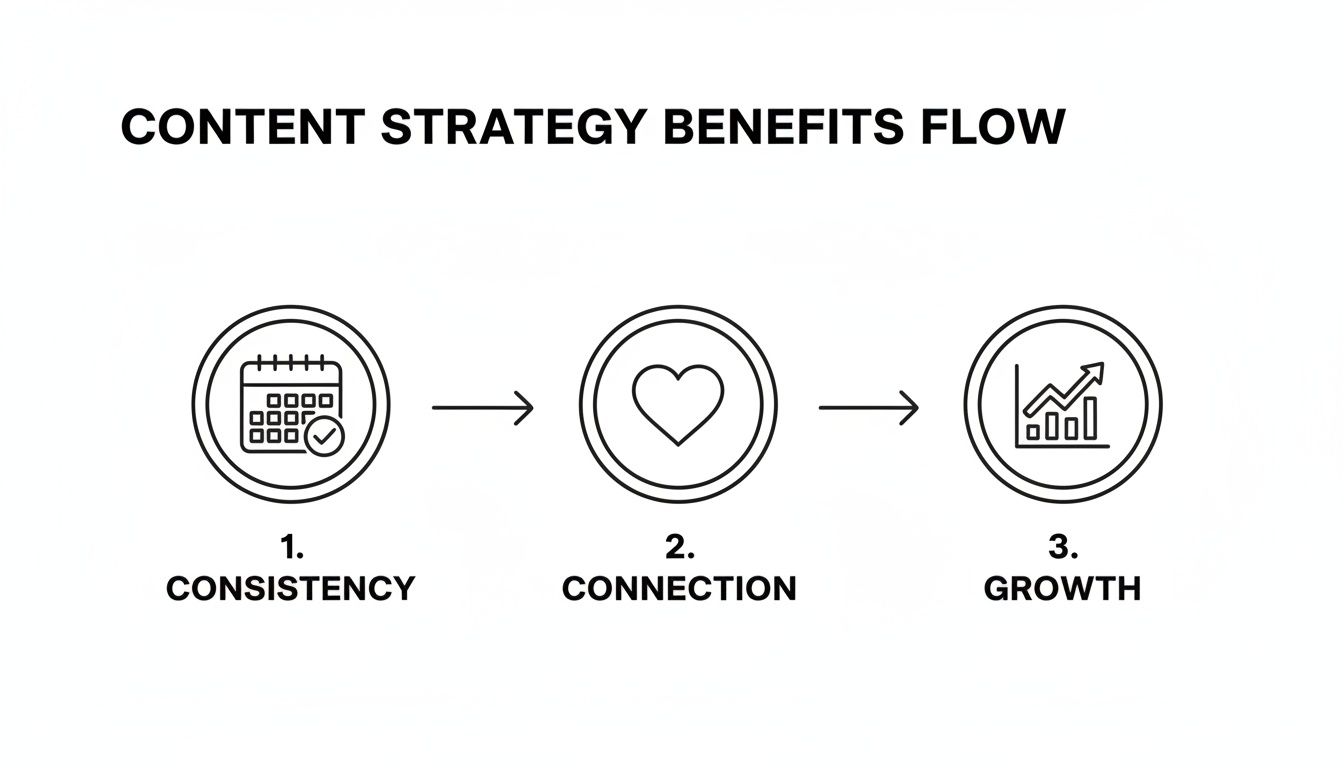
It shows a simple but powerful loop: consistent, strategic content builds a genuine connection with your audience, and that connection is what ultimately drives real, measurable growth. This isn't just theory—it's the exact process top creators use to build sustainable channels.
Your YouTube Content Strategy Checklist
To bring it all together, here’s a simple checklist to walk you through building your strategy from the ground up. Use it to make sure you've covered all the essential bases before you hit record.
| Step | Action Item | Key Question to Answer | Helpful Vidito Feature |
|---|---|---|---|
| 1. Mission & Goals | Write a one-sentence channel mission. Set 2-3 specific, measurable goals for the next 6 months. | Why does my channel exist, and what do I want to achieve? | N/A - This is your personal vision! |
| 2. Ideal Viewer | Create a simple persona for your target viewer, including their demographics and pain points. | Who am I making videos for, and what do they need from me? | Idea Validation - Test topics against your audience profile. |
| 3. Content Pillars | Define 3-5 core topics your channel will focus on. | What are the main content categories my channel will be known for? | Topic Explorer - Find sub-topics within your chosen pillars. |
| 4. Content & Distribution | Decide on your primary video formats (tutorials, vlogs, etc.) and a promotion plan for each video. | What kind of content will I create, and how will I get it seen? | Video Optimiser - Get SEO-friendly titles and descriptions. |
| 5. Editorial Calendar | Set up a calendar (spreadsheet, Trello, etc.) to plan and track your video production schedule. | How will I stay consistent and organised with my publishing schedule? | Content Calendar - Plan and schedule your content in one place. |
By working through this checklist, you're not just making random videos; you're building a content engine designed for long-term success.
Seeing Great Strategy in Action with Real Creators
Theory is one thing, but seeing a sharp content strategy out in the wild is what makes it all click. The frameworks we've been talking about aren't just abstract ideas; they're the blueprints that successful creators are using every day to build genuine communities and successful channels.
To bring this to life, let’s pull back the curtain on two very different but hugely successful UK-based YouTube channels. By looking at what they actually do, we can see how the five key ingredients—audience, goals, content pillars, distribution, and measurement—all work together to create an engine for growth.
We’ll start with a large team that keeps content fresh for millions, then dive into how a solo creator built an empire by starting with an incredibly tight niche.
Sorted Food: The Broad Appeal Strategy
Sorted Food is a masterclass in how to scale a channel by using multiple, well-defined content pillars. Their whole mission is to make food fun and accessible for a wide audience, from total beginners to experienced home cooks. Their strategy is a clever solution to a common problem: how do you cater to everyone without becoming boring?
Their content is built around distinct formats, almost like different shows on the same network:
- Gadget Reviews: They put the latest kitchen tech to the test, grabbing the attention of viewers who are curious about new products.
- Cooking Challenges: These are pure entertainment. Formats like "chefs vs. normals" or the "pass it on" challenge create a bit of drama and are perfect for a casual watch.
- Ultimate Recipes: This is where they deliver serious value. These in-depth videos establish them as authorities you can trust.
- Travel Vlogs: By exploring food in different places, they keep the channel visually exciting and broaden their appeal even further.
This multi-pillar approach is exactly why they can post so often without the channel ever feeling stale. Each format taps into a slightly different reason someone might watch, but they all tie back to that core idea of making food entertaining. Their titles are just as strategic, using clear, benefit-driven language like "We Put the £250 Smart Oven to the Test" or "Can 4 Chefs Cook the Same Dish with NO Recipe?" to tell you exactly what you're getting.
Ali Abdaal: The Laser-Focused Niche Strategy
In complete contrast, Ali Abdaal built his empire on an incredibly specific content strategy. He began by targeting a tiny audience: medical students in the UK who wanted to find better ways to study. His initial goal was simply to share the productivity systems that got him through his time at Cambridge University.
His early content pillars were ruthlessly focused:
- Evidence-Based Study Techniques (think active recall and spaced repetition).
- Productivity Hacks for Students.
- Technology for Learning (guides for tools like Notion and the iPad).
This laser focus meant he could completely own that niche. His video titles were designed to show up in search and solve a very specific problem, like "How I Remember Everything I Read." He wasn't just making videos; he was building the go-to resource for his ideal viewer.
This is a key takeaway: You don't need a massive audience to start; you need a dedicated one. Ali Abdaal proved that by solving a specific problem for a specific group, you can build immense authority and trust.
As his audience grew up and their problems changed, his strategy grew with them. He carefully expanded his content into broader topics like personal finance, entrepreneurship, and general well-being. But this expansion only came after he’d built a rock-solid foundation in his original niche. It’s a perfect example of starting small, owning a space, and then earning the right to go broader.
Both Sorted Food and Ali Abdaal show that a clear plan—a solid answer to what is content strategy for your channel—is the real secret to sustainable success on YouTube.
The Right Tools and Templates for Your Strategy
A content strategy is fantastic on paper, but bringing it to life day in, day out? That's where things can get tough. To avoid the burnout that comes from constant guesswork and administrative headaches, you need a solid toolkit.
The good news is, you don’t have to reinvent the wheel. There are some brilliant tools out there that can help you manage everything from that first spark of an idea all the way through to analysing your video's performance. Let's look at a few essentials that will make your workflow smoother and your strategy more effective.
Stop Guessing, Start Creating with Vidito
For most creators, the biggest creative bottleneck is staring at a blank document and wondering, "What on earth do I make a video about next?" This is precisely the problem Vidito was built to solve. It’s less of a tool and more of a strategic co-pilot for the ideation phase.
Instead of throwing spaghetti at the wall to see what sticks, Vidito’s AI Idea Generator gives you dozens of video concepts rooted in what people are actually searching for. But here’s the clever bit: it also attaches a Virality Score, search volume data, and a competition rating to each idea. This means you can gauge a video's potential before you even think about picking up a camera, making sure your time and effort are well spent.
This screenshot from Vidito shows just how easy it is to find video ideas that have a real shot at succeeding.
You can see at a glance which topics have high search potential and a strong virality score, giving you a data-backed reason to choose one idea over another.
Here’s a quick rundown of how you can find a winning idea in less than five minutes:
- Enter Your Niche: Just type your channel's main topic—say, "UK personal finance"—into the generator.
- Generate Ideas: The AI will instantly pull together a list of relevant video titles and angles.
- Analyse the Scores: Quickly scan the list for ideas with high search volume, low competition, and a promising virality score.
- Save Your Winner: Pop the best idea into your content library, and you're ready to start scripting.
It’s a simple process that shifts your brainstorming from a game of chance to a strategic, data-informed decision.
Building Out Your Creator Toolkit
While Vidito is a powerhouse for the early stages of your strategy, a couple of other tools are indispensable for managing the entire production line.
Your Editorial Calendar (Notion): When it comes to organising your publishing schedule, Notion is a creator's best friend. Its flexibility lets you build a simple content calendar to track a video's status (e.g., scripting, filming, editing), publish dates, and other key details. It puts your entire pipeline in one clear, easy-to-manage place.
Performance Analysis (YouTube Studio): Your strategy isn't set in stone; it’s a living thing that needs feeding with data. YouTube Studio is where you get that data. Make a habit of checking your analytics to see how things like Audience Retention and Click-Through Rate (CTR) are performing. This is how you learn what truly connects with your viewers.
Thumbnail Design (Canva): A brilliant video can easily get lost without a thumbnail that screams "click me!" Canva makes it ridiculously easy to create professional-looking thumbnails, even if you have zero design skills. Their templates give you a huge head start.
This kind of strategic approach couldn't be more relevant right now. In the UK, a massive 83% of consumers say they want to see more video from brands and creators. This has pushed 77% of marketers to use social video and 59% to create how-to guides—exactly the type of content Vidito helps you find. With video being the best-performing content type for 45% of UK marketers, having a tool that helps you consistently find clickable ideas is a serious advantage. You can dig into more of these numbers in this UK content marketing statistics report.
When you combine these tools, you're not just making videos—you're building a seamless system that supports your content strategy from start to finish. It's how you move from hoping for the best to publishing with confidence.
How to Measure and Evolve Your Strategy Over Time
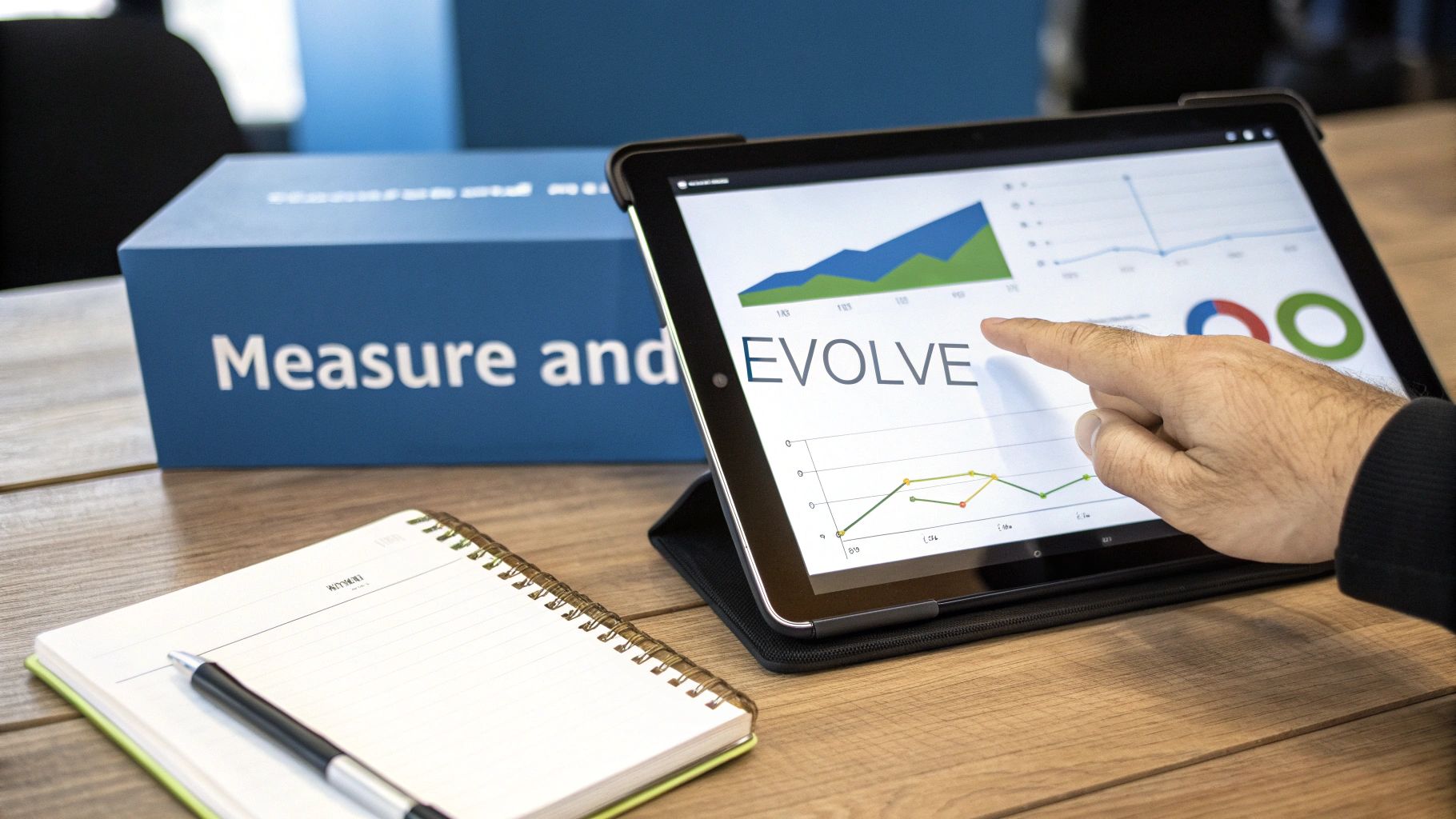
A great content strategy is never finished. Think of it as a living, breathing plan that gets smarter with every video you publish. To make it evolve, you have to listen to what your data is telling you. This means moving beyond vanity metrics like subscriber counts and focusing on what truly signals a healthy, growing channel.
The real goal is to use analytics not just to see what happened, but to figure out why it happened. This insight is what turns a good creator into a great one. It lets you consistently refine your approach based on real audience behaviour instead of just guesswork.
The Metrics That Truly Matter
To really get a feel for your performance, you need to look at the numbers that measure audience engagement. These are the three core metrics inside your YouTube Studio that tell the real story of how viewers are responding to your videos.
- Click-Through Rate (CTR): This is the percentage of people who see your video pop up in their feed and actually click to watch it. A low CTR (usually under 4%) often points to a problem with your packaging—your title isn't compelling, or your thumbnail isn't grabbing anyone's attention.
- Audience Retention: This graph is your best friend for finding out exactly when viewers are dropping off. A sharp decline in the first 30 seconds? Your hook isn't strong enough. A big dip in the middle might mean a section was confusing or just plain boring.
- Watch Time: This is the total amount of time people spend watching your videos. YouTube's algorithm absolutely rewards channels that keep viewers on the platform longer, making this a critical metric for growth.
By diagnosing issues using these three metrics, you can make targeted, meaningful improvements. You can get a much deeper understanding by reading our complete guide on YouTube analytics for creators.
A Simple Framework for Monthly Review
Data is pretty useless without action. To make sure your strategy is actually getting better, set aside some time once a month to review your channel’s performance with a clear, simple framework. This process keeps you accountable and helps you make smart, small improvements that add up over time.
Practical Example: Let's say a gaming channel like The Spiffing Brit notices their videos about obscure game exploits have a much higher Audience Retention than their standard game reviews. His monthly review would lead to a hypothesis: "If I create more 'game-breaking' exploit videos, then my average watch time will increase." His actionable goal for the next month becomes "produce two more exploit videos and compare their performance to my baseline."
Here’s a practical review you can run every month:
- Identify Top Performers: Look at your top three videos from the past month. What do they have in common? Was it the topic, the format, or maybe the thumbnail style?
- Analyse Underperformers: Now, find the bottom three videos. Where did they fall short? Did they have a poor CTR, or did audience retention plummet right away? Be honest about what didn't connect.
- Form a Hypothesis: Based on what you've found, create a simple "if-then" statement. For example, "If I create more tutorial-style videos, then my average watch time should increase."
- Set One Actionable Goal: Don't try to fix everything at once. For the next month, focus on one specific improvement, like "I will A/B test two different thumbnail styles" or "I will script a stronger hook for every single video."
This cycle of analysing, hypothesising, and acting is what keeps your content strategy dynamic and effective, ensuring your channel is always getting better.
Still Have a Few Questions?
Let's clear up some of the common sticking points that creators run into when building their YouTube content strategy. Getting these final details right can be the difference between a plan that actually works and one that just sits on your hard drive.
Strategy vs. Calendar: What's the Real Difference?
This is a big one. People often use these terms interchangeably, but they're two very different things.
Think of it like building a house. Your content strategy is the architect's blueprint. It's the grand plan that defines why you're building, who it's for (your audience), what rooms you'll have (your content pillars), and what the overall style will be.
Your content calendar, on the other hand, is the construction schedule. It's the practical, ground-level plan that says, "On Monday, we lay the foundation; on Tuesday, we put up the walls." It's the what and the when—the specific video that goes live on a specific day. You can't have a successful build without the blueprint.
How Often Should I Revisit My Strategy?
Your content strategy isn't something you carve in stone and never touch again. The YouTube world moves fast, and your plan needs to keep up.
A deep-dive review every quarter is a great rhythm to get into. That gives you enough time and data to spot meaningful trends without knee-jerk reactions to a single video's performance.
That said, you should be glancing at your key metrics—things like click-through rate and audience retention—on a monthly basis. This is more like a routine check-up. It lets you make small, intelligent tweaks along the way, like experimenting with new thumbnail designs or refining your opening hooks. It’s all about continuous, small improvements.
Is There a Magic Number for Posting Frequency?
Daily? Weekly? Twice a month? The honest, no-fluff answer is that there isn't one perfect number for everyone.
The golden rule is this: consistency and quality will always beat sheer quantity. A single, brilliant video once a week that your audience loves is infinitely better than three rushed, mediocre videos that don't hit the mark.
Look at your own life and resources. Pick a schedule you know you can stick to without burning out or letting your quality slip. That's your magic number.
What if My Strategy Just Isn't Working?
It happens. And when it does, it's tempting to want to throw everything out and start over. But pivoting doesn't have to mean a complete teardown.
Dive into your analytics and find the bright spots, no matter how small. Is there a particular video format that got slightly better watch time? A topic that sparked more comments than usual?
Focus on those glimmers of what is working. You can then begin to gently shift your content in that direction, introducing new ideas that align with those successes. It's about evolving, not starting from scratch, and bringing the audience you've already built along for the ride.
Ready to stop guessing and start creating with confidence? Vidito is your AI-powered partner for generating and validating viral video ideas on autopilot. Get data-backed concepts, click-worthy titles, and a clear path to your next successful video. Discover your next hit idea.