How to Promote Videos on YouTube A Proven Growth Playbook
The secret to promoting your YouTube videos isn't really a secret at all. It comes down to a simple, powerful formula: optimise for search discoverability first, then amplify that content to a wider audience.
This process starts long before you even think about hitting 'publish'. You have to treat YouTube for what it is—the world's second-largest search engine. That means meticulously crafting your video's title, description, and tags to perfectly match what your ideal viewers are already looking for.
Mastering YouTube SEO for Discoverability
Before your video can wow an audience, that audience has to find it. So many creators fall into the trap of making fantastic content but then completely neglecting the single most important promotional step: optimising for search.
Think of YouTube SEO less like a technical chore and more like building a big, clear signpost that points interested viewers directly to your video. Promotion isn't just about what you do after you upload; it's baked right into the pre-production process. Your strategy has to start with understanding what people are actually typing into that search bar.
Finding the Right Keywords to Target
Keywords are the bridge connecting a viewer's question to your video's answer. Getting this right is the difference between getting lost in the noise and showing up at the top of the search results.
You can kick off your research right on YouTube itself. Start typing a broad topic related to your niche into the search bar and pay close attention to what YouTube's autocomplete suggests. These aren't guesses; they're real searches from real users, giving you a direct line into what your audience wants to know.
For instance, a cooking channel might start by typing "how to make sourdough" and see suggestions pop up like:
- "how to make sourdough bread for beginners"
- "how to make sourdough starter from scratch"
- "how to make sourdough bread no-knead"
These aren't just keywords; they're fully-formed video ideas with a built-in, hungry audience. This foundational research ensures you're creating content people are actively looking for. For a deeper dive, our guide on how to find low-competition keywords has some more advanced techniques.
The Anatomy of a Perfectly Optimised Video
Once you've zeroed in on your target keyword, it's time to weave it into your video's metadata—that's your title, description, and tags. Each of these elements plays a specific role in telling YouTube's algorithm what your video is all about.
A killer title has to do two jobs at once: satisfy the algorithm with the right keywords and entice a human to actually click. It needs to be clear, promise a benefit, and include your main keyword, preferably as close to the beginning as possible.
Your video description is where you can provide deeper context. The first couple of lines are crucial because they're what viewers see in the search results. Use this space to expand on the promise of your title, naturally working in your primary keyword and a few related ones. The goal isn't to just stuff it with keywords; it's to write a compelling summary that tells both viewers and the algorithm exactly what value your video delivers.
This simple flow chart breaks down how research and optimisation fit together before you even think about publishing.
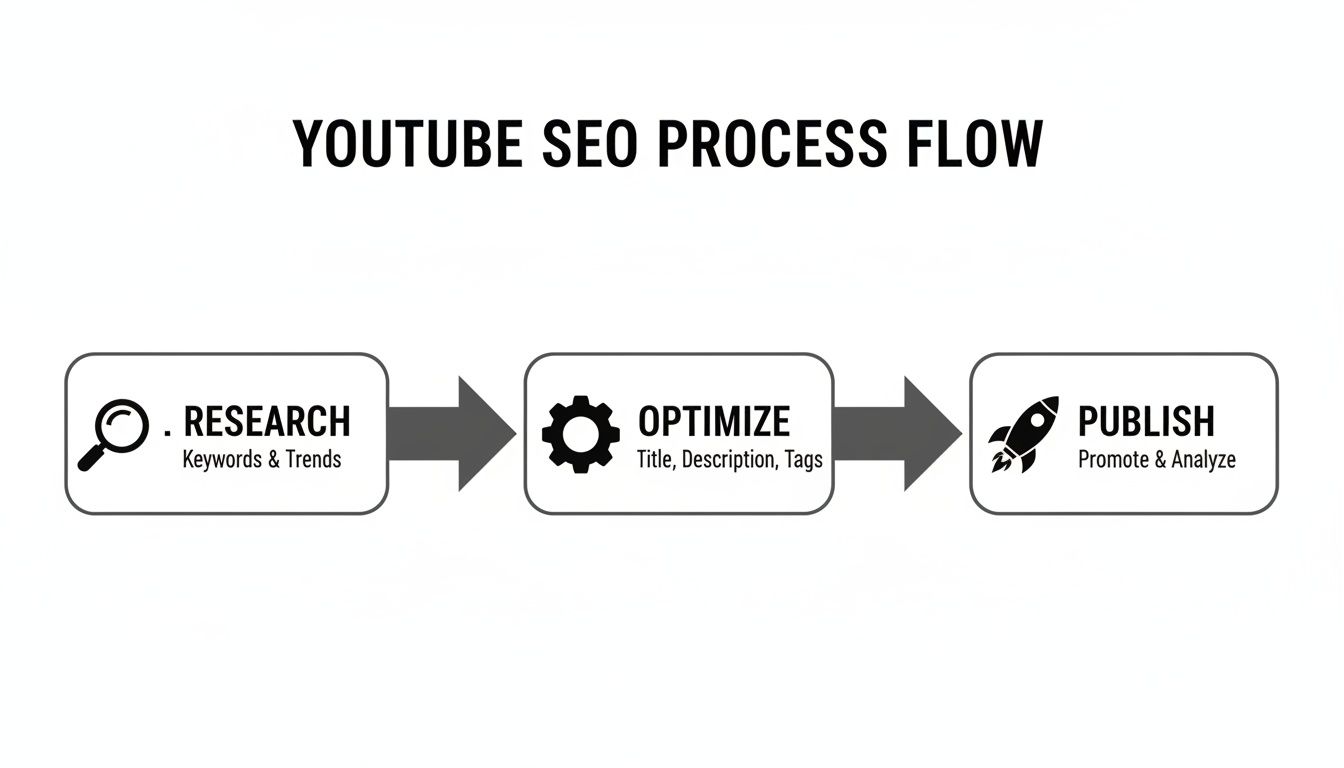
As the visual shows, successful promotion is a deliberate process, not a happy accident. It all starts with solid research.
To make sure you're hitting all the key points every time, use this checklist as a quick reference before you publish.
YouTube SEO Optimization Checklist
| Optimization Element | Key Action | Example |
|---|---|---|
| Video Title | Include the main keyword near the beginning. Make it compelling and benefit-driven. | "How to Make Sourdough Bread for Beginners (Easy No-Knead Recipe)" |
| Video Description | Write a 2-3 sentence summary with your main keyword in the first line. Add chapters, links, and related keywords. | "Learn how to make sourdough bread for beginners with this simple recipe! In this video, we'll cover..." |
| Tags | Add your primary keyword first, then a mix of broad and specific secondary keywords. | "sourdough bread", "sourdough for beginners", "homemade bread", "baking", "no-knead bread recipe" |
| Thumbnail | Design a high-contrast, easy-to-read thumbnail that sparks curiosity and stands out in search results. | A bright, clear photo of a perfect loaf of bread with bold text like "EASIEST SOURDOUGH EVER!" |
| Spoken Keywords | Say your main keyword naturally within the first 15-30 seconds of your video. | "Hey everyone, today I'm going to show you exactly how to make sourdough bread, even if you're a total beginner." |
Following these steps for every video builds a strong foundation for organic growth and ensures your content has the best possible chance of being discovered.
A Real-World Case Study: MKBHD
Look at how a pro like tech reviewer Marques Brownlee (MKBHD) does it. When a new phone comes out, he doesn't just title his video "iPhone 15 Review". He gets much more specific with titles like "iPhone 15 Pro Review: The Good, The Bad, & The Ugly!"
That title works brilliantly because it targets the main keyword ("iPhone 15 Pro Review") while also making you curious. His descriptions are incredibly detailed, packed with timestamps (chapters) and relevant links, all loaded with keywords about the phone's features like "Action Button," "USB-C," and "camera test." This comprehensive approach is why his videos completely dominate the search results for all sorts of queries related to that product.
This strategic focus on metadata is non-negotiable. YouTube's algorithm is more search-driven than ever, heavily rewarding creators who put in the time to properly optimise their content. For real growth, treating YouTube like a search engine is no longer just an option—it's essential.
Using YouTube’s Built-In Promotional Tools
So, you’ve spent hours nailing your video’s title, description, and tags. What’s next? The real promotional work starts the second you hit that publish button. Thankfully, YouTube gives you a fantastic set of free, built-in features to get more eyes on your content and, crucially, keep people watching.
Learning to master these tools is genuinely one of the most powerful things you can do to promote your videos without spending a penny. Think of each video not as a standalone piece, but as a doorway. Your mission is to guide viewers through that door and into a deeper exploration of your channel.
Turn Viewers Into Binge-Watchers with End Screens and Cards
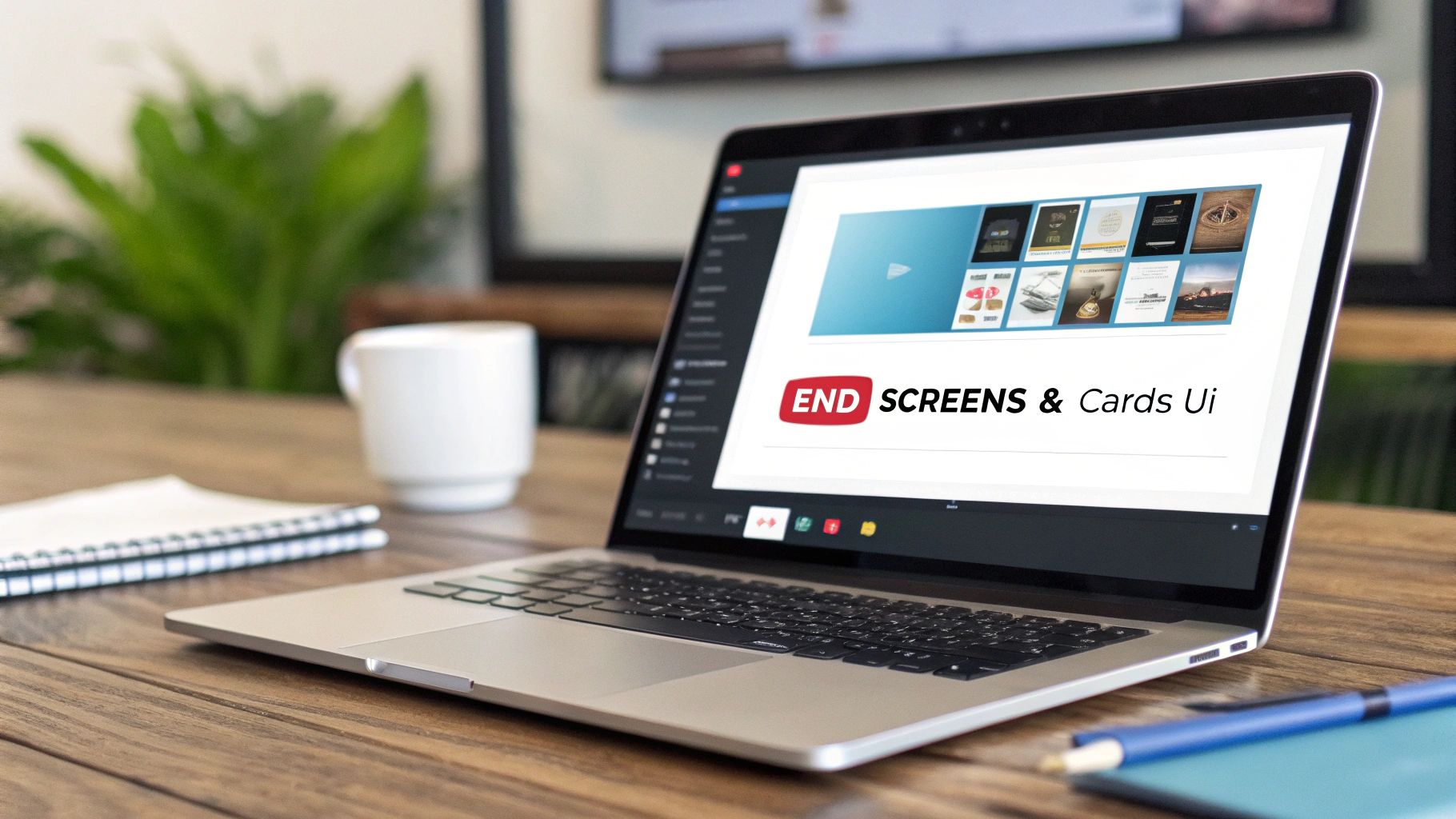
Those final 5-20 seconds of your video? That's prime real estate. An End Screen is a customisable overlay where you can drop in clickable elements to promote your other content. Instead of just letting viewers fade away or get distracted by another creator's video, you get to tell them exactly what to do next.
A lot of creators just throw random videos onto their End Screens, which is a huge missed opportunity. You need to be strategic.
- Offer a logical next step: If you've just uploaded 'Part 1' of a tutorial, it’s a no-brainer to link directly to 'Part 2' in the End Screen.
- Showcase a proven winner: Dive into your YouTube Analytics, find a video with fantastic audience retention, and feature that. It’s already demonstrated its ability to keep people engaged.
- Ask for the sub: Always, always include a subscribe button. Sometimes all a viewer needs is a simple, direct prompt to join your community.
YouTube Cards are the more subtle cousin of End Screens. They're little interactive pop-ups that can appear at any point during your video. If you mention a specific tool or reference an older video, you can set a card to appear at that exact moment, giving viewers a direct, contextual link to click. For a great case study, look at the gaming channel Game Theory. At the end of every video, host MatPat strategically uses the end screen to link to a related theory video, keeping viewers in a cycle of discovery within his channel.
Create Content Journeys with Playlists
Playlists are, without a doubt, one of the most underrated promotional tools on the entire platform. When you group related videos, you're not just tidying up your channel; you're creating a frictionless viewing experience that can seriously boost your watch time. Once one video finishes, the next one in the series just starts playing automatically. It’s the key to getting viewers hooked.
Think thematically. A cooking channel isn't just a jumble of recipes; it has playlists for "30-Minute Weeknight Dinners," "Advanced Baking Techniques," or "Vegan Holiday Feasts." A great real-world example is Yoga with Adriene. She organises her videos into playlists like "30 Days of Yoga" or "Yoga for Beginners," guiding new viewers on a clear path and encouraging long watch sessions. This not only helps viewers find what they want but also signals to the YouTube algorithm that you're an authority on these specific subjects.
Creating well-structured playlists does more than just organise your content; it builds viewing momentum. A viewer might discover your channel through one video but become a subscriber after binge-watching an entire playlist that solves their problem from start to finish.
Enhance Viewer Experience and SEO with Chapters
Breaking your video down into Video Chapters with clear, descriptive titles is a brilliant two-for-one promotional tactic. First off, it massively improves the viewing experience. People can easily skip to the sections they care about most, which makes them happier and more likely to stick around.
But secondly, chapters are an absolute goldmine for SEO. Google and YouTube can index your chapter titles, which means specific segments of your video can actually show up in search results. You’re no longer just ranking for your main topic, but for all the mini-topics within it.
Take the channel LegalEagle, for example. They are masters of this. A 30-minute video breaking down the legal accuracy of a film might have chapters like "The Botched Crime Scene," "Analysing the Courtroom Drama," and "The Verdict's Flaws." This makes their long-form content incredibly easy to digest and helps the video rank for dozens of specific search terms. By making content skimmable and searchable, they win on both viewer satisfaction and discoverability. Of course, great content also needs a great publishing schedule, and you can learn more by checking out the best times to post on YouTube.
Building a Community for Organic Promotion
Chasing views is one thing, but if you want sustainable, long-term growth, you need to build a loyal community. This is where the real magic happens. It’s about turning passive viewers into dedicated fans who feel a genuine connection to you and your channel.
Think of it this way: when people feel like they're part of something, they become your biggest champions. They’re the ones who will engage, share, and shout about your videos without you even having to ask. It's a fundamental shift from just broadcasting content to actually fostering a real community. Your goal is to create a space where your audience feels seen, heard, and valued.
Spark Conversations with the Community Tab
Your channel's Community Tab is basically your own private social media feed, and it’s a seriously powerful tool for keeping your audience hooked between video uploads. Don't let it gather dust.
Here are a few simple but effective ways to use it:
- Run polls: Ask your audience what they want to see next. Getting them involved in your creative process makes them feel like they have a real stake in your channel.
- Share behind-the-scenes snaps: A quick photo of your filming setup or a sneak peek of an upcoming project adds a personal touch that makes you more relatable.
- Post text updates or GIFs: You can ask questions, share a quick thought, or just check in. It’s a low-effort way to maintain a high level of connection.
A great example is the creator Roberto Blake, who constantly uses the Community Tab to ask his audience about their creative struggles, which he then turns into future video topics. This consistent interaction keeps you top-of-mind, making subscribers way more likely to click when your next video finally drops.
The Non-Negotiable Act of Replying to Comments
The comment section is where your community truly comes alive. Ignoring it is like throwing a party and then hiding in the kitchen. Getting in there and replying to comments is one of the most direct and effective ways to make people feel like they belong.
When someone takes the time to leave a thoughtful comment, even a simple reply shows you're paying attention. Pinning brilliant comments is another great move—it rewards engagement and encourages others to join the conversation. These small actions can turn a casual viewer into a lifelong fan. For more ideas on this, check out our guide on how to get subscribers on YouTube.
MrBeast is an absolute master of this. He constantly pulls video ideas directly from his fans on social media and in the comments, making them a core part of his strategy. By involving his audience so directly, he creates an army of advocates who are personally invested in seeing every video succeed.
Leverage Collaborations for Mutual Growth
Partnering up with other creators in your niche is a classic YouTube growth strategy for a reason: it works. It's the ultimate win-win, introducing your content to a fresh, highly relevant audience that’s probably going to like what you do.
Finding the right person to collaborate with is crucial. Look for channels that are a similar size to yours and have a similar target audience, but aren't direct competitors. For example, a channel that reviews fancy coffee beans could team up with one that teaches latte art. See the synergy? One of the most famous early YouTube collaborations was between Shane Dawson and The Fine Bros (now FBE), which exposed both channels to millions of new subscribers and helped define the collaboration trend.
Here's a simple approach for pitching a collab:
- Engage First: Don't just slide into their DMs cold. Genuinely engage with their content for a while. Leave thoughtful comments on their videos and follow them on social media.
- Personalise Your Pitch: When you do reach out, show you’ve done your homework. Mention a specific video of theirs you loved and explain why you think your audiences would gel.
- Propose a Concrete Idea: Never just say, "we should collab". Come with a specific, mutually beneficial idea ready to go. Suggest a format, whether it’s a joint video, a guest spot, or even a simple shout-out swap.
A great collaboration can bring a huge wave of new, engaged subscribers who are already primed to enjoy your content. It’s one of the fastest ways to expand your community and your promotional reach.
Expanding Your Reach Beyond the YouTube Platform
If you really want to scale your video promotion, you have to start thinking outside the YouTube box. Just waiting for the algorithm to discover you is a painfully slow game. The real growth comes from building a powerful distribution engine—taking your core video and breaking it down into dozens of smaller assets to share across other platforms.
This isn't about just dropping a link to your latest video on your Facebook page and calling it a day. It’s about being strategic. You need to repurpose your content into native formats that feel right for each platform, whether that's a snappy vertical clip for Instagram Reels or a thought-provoking text post for LinkedIn.
The Power of Native Content Repurposing
Every social platform has its own unwritten rules, its own culture, and its own audience expectations. A ten-minute, in-depth video that does brilliantly on YouTube will probably fall flat on TikTok, where short, fast-paced vertical content is king. Smart promotion means respecting these differences.
Instead of just sharing a link, create native content. This just means grabbing the most valuable, interesting, or entertaining moments from your main video and editing them into standalone clips made specifically for other platforms.
This approach gives you two massive advantages:
- It meets your audience where they already are: You're not trying to drag a TikTok user away from their favourite app. You're giving them a taste of your value in a format they already know and love.
- It creates countless entry points to your channel: One long-form video can be spun into endless pieces of micro-content. Each one acts like a little signpost pointing back to your main channel.
For example, imagine you’ve just filmed a 15-minute review of some new software. You could easily pull out a 30-second TikTok showing off its single best feature, a one-minute Instagram Reel demonstrating a quick-win tip, and a text-based post on LinkedIn sharing a key insight. Same core content, three different native formats.
Harnessing YouTube Shorts to Capture New Audiences
Before you even think about leaving YouTube, your first and most powerful repurposing tool is right there in front of you: YouTube Shorts. Shorts often attract a completely different slice of the audience, especially those who prefer quick, vertical, scrollable content.
This format is perfect for isolating the most impactful 60 seconds from your longer video. Did you tell a great story, reveal a surprising statistic, or share a game-changing tip? Clip that moment, add some captions, and publish it as a Short.
Crucially, Shorts act as a gateway to your primary content. Think of them as trailers. A compelling Short can spark enough curiosity to get a viewer to click through to your channel and watch the full-length video it came from.
For UK creators, it's worth noting that YouTube Shorts are a huge promotional tool. A staggering 40% of Shorts users aren't active on TikTok or Instagram Reels, representing a unique and often untapped audience. The viral potential is immense—just look at MrBeast's 'Would You Fly to Paris for a Baguette?', which became the most-liked video on YouTube with 54 million likes as a Short.
The Gary Vaynerchuk Content Pyramid Model
If you want to see content repurposing done at an elite level, look no further than entrepreneur Gary Vaynerchuk. His "content pyramid" model is a masterclass in maximising the value of a single piece of content to promote your YouTube videos.
The concept is beautifully simple:
- Pillar Content: Start with one long-form piece of content—a keynote speech, a podcast, or a detailed YouTube video. This is the top of your pyramid.
- Micro-Content: Systematically break down that pillar content into dozens of smaller pieces. We’re talking short video clips, audio snippets, image quotes, GIFs, and text-based posts.
- Distribution: Share these micro-pieces across every relevant social platform, always tailored to that platform's native format.
With this model, a single one-hour podcast can be turned into 30-50 individual assets. This relentless distribution ensures his message hits the widest possible audience across every channel imaginable. It’s the blueprint for building a true content machine.
Thinking about repurposing from the very start is key to making this process efficient. The table below outlines a simple framework for how one YouTube video can be spun into multiple assets for different platforms.
Content Repurposing Strategy
| Platform | Content Format | Promotional Goal |
|---|---|---|
| YouTube Shorts | 60-second vertical clip of a key moment | Drive discovery and channel subscriptions |
| Instagram Reels | 30-90 second vertical clip with trending audio | Increase brand visibility and engagement |
| TikTok | 15-60 second fast-paced, captioned vertical clip | Tap into trends and reach a younger demographic |
| Text post with a key insight + a 2-min clip | Establish thought leadership and professional authority | |
| Twitter (X) | Thread breaking down key points, with a GIF/clip | Spark conversation and drive traffic |
| Blog Post | Embedded video with a written transcript/summary | Boost SEO and provide an alternative format |
| Email Newsletter | Animated GIF of a key moment, linking to the video | Nurture your existing audience and drive views |
This structured approach ensures you’re not just re-posting, but strategically re-formatting your content to make a genuine impact on every platform.
Engaging in Communities Without Being Spammy
Online communities like Reddit and Facebook Groups can be absolute goldmines for promotion, but you have to play by their rules. The golden rule is "give, give, give, then ask." Just dropping a link to your video is the quickest way to get yourself banned and alienate potential fans.
The trick is to become a real member of the community first. Find subreddits or groups that are a perfect fit for your niche and start by providing genuine value. Answer questions, join in discussions, and share your expertise without asking for anything in return. For instance, a creator with a video on restoring old furniture might frequent the r/woodworking subreddit, answer questions about specific techniques for weeks, and only then share their video when someone asks, "Does anyone have a good guide on stripping paint from oak?"
Only after you've built up some goodwill should you share your video—and only when it directly solves a problem or answers a question being discussed. Frame it as a helpful resource, not a shameless plug. Something like, "I actually made a detailed video explaining this exact process, you can check it out here if it's helpful," works wonders. This value-first approach builds trust and sends highly qualified, interested viewers your way. To truly amplify your reach, understanding the mechanics of what makes content spread is crucial. Learning how to make viral videos can add rocket fuel to your message and expand your audience far beyond your immediate subscriber base.
Pouring Petrol on the Fire with Paid YouTube Ads
Organic growth is the foundation of a strong channel, but let's be honest, sometimes you need to give your videos a real push. When you're ready to add some fuel to the fire, paid promotion is a seriously powerful way to speed things up.
Dipping your toes into YouTube Ads can feel a bit daunting, I get it. But even a small, strategically placed investment can give your content the nudge it needs to catch the algorithm's attention and find its perfect audience much faster. Think of it less as a shortcut and more as a spotlight. You're not buying fake views; you're paying to put your brilliant video right in front of the people most likely to actually care about it.
Getting to Grips with Ad Formats
Before you start a campaign, you need to know what you're working with. While YouTube has a few different ad types, most creators will find themselves choosing between two main options.
- In-Stream Ads: These are the ads everyone knows—the ones that pop up before, during, or after another video. You can set them as 'skippable' after five seconds or 'non-skippable' for shorter, punchier messages. They're great for grabbing attention and making people aware you exist.
- In-Feed Ads (what used to be called Discovery Ads): This is where it gets interesting for creators. These ads show up as a promoted video in search results, on the YouTube homepage, or in that all-important "Up next" sidebar. This format is gold for getting discovered because people have to actively click to watch, meaning you get highly motivated viewers.
For most of us trying to get more eyes on a specific video, in-feed ads are the best place to start. They feel more natural, less interruptive, and they deliver an audience that has already decided your content looks interesting.
Kicking Off Your First Campaign
Launching your first ad is probably more straightforward than you imagine. It all runs through the Google Ads platform, which hooks straight into your YouTube channel. The secret to a winning campaign isn't a massive budget; it's getting your targeting spot-on.
You can get incredibly specific about who sees your ad, which means you won't be wasting your money. You can target people based on:
- Demographics: Age, gender, location, and language.
- Interests: What they're into, like "home cooking" or "indie gaming."
- Placements: This is a game-changer. You can literally tell YouTube to show your ad to people who are watching specific channels that you know your ideal viewer loves.
This level of control is what makes paid ads so effective. The potential is huge—YouTube is projected to have 2.85 billion monthly active users, and its ads can reach a staggering 2.53 billion people. Here in the UK, the platform's 90.4% penetration rate means you have an enormous, highly engaged audience right on your doorstep. You can find more of these insights in these video marketing statistics on lambdafilms.co.uk.
A successful YouTube ad campaign is less about how much you spend and more about how well you target. A modest budget aimed at a hyper-specific niche will always outperform a large budget aimed at a broad, undefined audience.
A Real-World Example
Let's say you run a channel teaching people how to get organised with Notion. You’ve just spent ages creating a brilliant, in-depth tutorial on building a content calendar.
Instead of just uploading and hoping for the best, you could run a small in-feed ad campaign with a budget of just £5 a day. You'd make your targeting razor-sharp:
- Audience: People in the UK and USA, aged 25-45.
- Interests: "Productivity Software" and "Project Management Tools."
- Placements: You tell YouTube to show your ad to viewers of big productivity channels like Ali Abdaal or Thomas Frank.
Suddenly, your tutorial is appearing as a recommended video to an audience that's already watching similar stuff. This initial wave of high-quality views is a powerful signal to the algorithm that your video is worth watching. This can give your organic rankings a serious boost and help you reach an even bigger audience.
Of course, for those purely focused on rapid channel growth, some creators look into services where you can buy YouTube subscribes as a more direct way to increase their numbers quickly.
Got Questions About Promoting Your Videos? We’ve Got Answers.
Jumping into the world of YouTube promotion often feels like you have a million questions and no clear answers. Let's tackle some of the most common ones that pop up for creators, so you can move forward with a bit more clarity.
What’s the Best Time to Post My YouTube Video?
Honestly, there's no magic "golden hour" that works for every single channel. The best time to publish is simply when your viewers are online and ready to watch. A gaming channel's audience might be most active late at night, while a channel for new parents could see a peak during nap time in the early afternoon.
The only way to know for sure is to dive into your YouTube Analytics.
Go to the 'Audience' tab and look for the 'When your viewers are on YouTube' report. It’s a handy little heat map that shows you exactly when your subscribers are browsing. My advice? Try publishing one or two hours before those peak activity times. This gives YouTube's system enough time to index your video, so it's ready to be served up right as your audience starts logging on.
How Long Does It Take to See Real Results from Promotion?
This is the classic "how long is a piece of string?" question, because the answer really does vary. If you’ve nailed your YouTube SEO, you're playing the long game. You might see a slow, steady increase in views over weeks or even months as your video begins to rank for different search terms. Think of it as a snowball gathering momentum.
On the other hand, a big push on social media or a shout-out from another creator can send a huge wave of traffic your way within 24-48 hours. Paid ads, of course, can deliver traffic almost instantly. Most creators find a mix works best: expect a little bump from your initial promotion in the first week, but look for that sustained, organic growth from good SEO to kick in over the following months.
Should I Focus on SEO or Social Media First?
Always, always, always start with YouTube SEO. Your title, description, and tags are the foundation your video is built on. Getting this right before you hit 'publish' is non-negotiable. It’s what allows people to discover your content on the platform for months, and even years, to come.
Once that foundation is solid, then you hit social media to light the fuse. Sharing clips and links on places like Instagram, TikTok, or relevant Reddit communities provides that critical first burst of views. This initial engagement sends a powerful signal to the YouTube algorithm that your content is worth paying attention to.
SEO and social media aren't an either/or choice; they're a partnership. SEO gives your video long-term staying power, while social sharing gives it the immediate push it needs to get off the ground.
How Can I Promote My Channel with No Money?
You absolutely can grow a channel without a single penny for advertising. It just means you're trading money for time, creativity, and a bit of hustle.
- Go All-In on YouTube’s Own Tools: Get meticulous with your End Screens, Cards, and Playlists. Your goal is to create a seamless viewing experience that encourages people to watch one video after another.
- Be Genuinely Helpful in Your Niche: Find the subreddits, Facebook Groups, or online forums where your target audience hangs out. Don't just spam your links. Instead, become a valued member of the community by answering questions and offering advice. Share your video only when it's the perfect, most helpful answer to someone's problem.
- Slice and Dice Your Content: One long-form video can become a goldmine of smaller content. Turn key moments into YouTube Shorts, interesting clips into Instagram Reels, and funny bits into TikToks. Each one acts as a little breadcrumb leading back to your main channel.
- Collaborate with Your Peers: Reach out to other creators who are at a similar stage of growth. You can swap shout-outs, appear in each other's videos, or work on a joint project. It's one of the most powerful ways to get in front of a new, highly relevant audience for free.
Ready to stop guessing and start creating videos your audience is actually searching for? Vidito is your AI-powered partner for generating and validating viral video ideas. Get data-backed concepts, click-worthy titles, and thumbnail suggestions in seconds. Try Vidito for free today!