How to Get Subs on YouTube and Build a Loyal Following
Getting people to subscribe to your YouTube channel really comes down to one simple idea: create a channel that delivers consistent value and shows people what it's about instantly. You're building a home for your target audience, a place where they feel like you 'get' them. When you nail that, subscribing becomes a no-brainer. This all starts with a clear niche, strong branding, and smart content organisation.
Build a Channel People Actually Want to Subscribe To
Before you start obsessing over subscriber counts, you have to get the foundations right. Think of your YouTube channel as your digital shopfront. If it’s messy, confusing, or looks unprofessional, potential subscribers will click away without a second thought.
The goal is to help a first-time visitor understand exactly what you do and why they should stick around. This isn't just about looking pretty; it's about communicating your purpose and building trust from the very first impression.
A well-built channel answers the silent questions every viewer has: "What's this all about?", "Is this for me?", and "What's in it for me if I subscribe?". Getting this right is the most important first step you can take.
Define Your Niche and Value Proposition
First things first, you need a laser-focused niche. A channel that tries to be "a little bit of everything" ends up being for no one. Are you the go-to person for budget-friendly vegan recipes? Do you break down complex software for beginners? Get specific. Your value proposition is the promise you make to your audience—what they'll get from watching your videos.
Case Study: MrBeast. His value proposition is crystal clear: tune in for over-the-top entertainment and mind-blowing generosity. A new viewer gets it immediately from titles like "I Gave People $1,000,000 But ONLY 1 Minute To Spend It." That kind of clarity is what turns a casual view into a subscription, because they know exactly what kind of videos to expect next.
Key Takeaway: A tight niche with a clear promise will always beat a broad channel with a fuzzy identity. People subscribe when they're confident you'll keep delivering the stuff they came for.
Create a Professional and Cohesive Brand
Your channel's visual identity is your handshake. This covers your profile picture, your channel banner, and even your video thumbnails. They should all feel connected—using a consistent colour palette, font, and style—to build a brand that people start to recognise.
- Channel Banner: This is prime real estate. Practical Example: The tech channel Linus Tech Tips uses their banner to show the faces of their main hosts, their logo, and a tagline, "As seen on TV* (*-not actually seen on TV)," which instantly communicates their expertise and quirky personality.
- About Section: So many creators ignore this! Write a short, punchy, and keyword-rich description of your channel. Explain who you are, what you make, and who you're making it for. This helps both real people and the YouTube algorithm figure out what you’re all about. For a deeper dive, check out our guide on setting up a YouTube channel properly.
This whole process is about laying the right groundwork, moving from your core niche to your branding, and then organising it all with playlists.
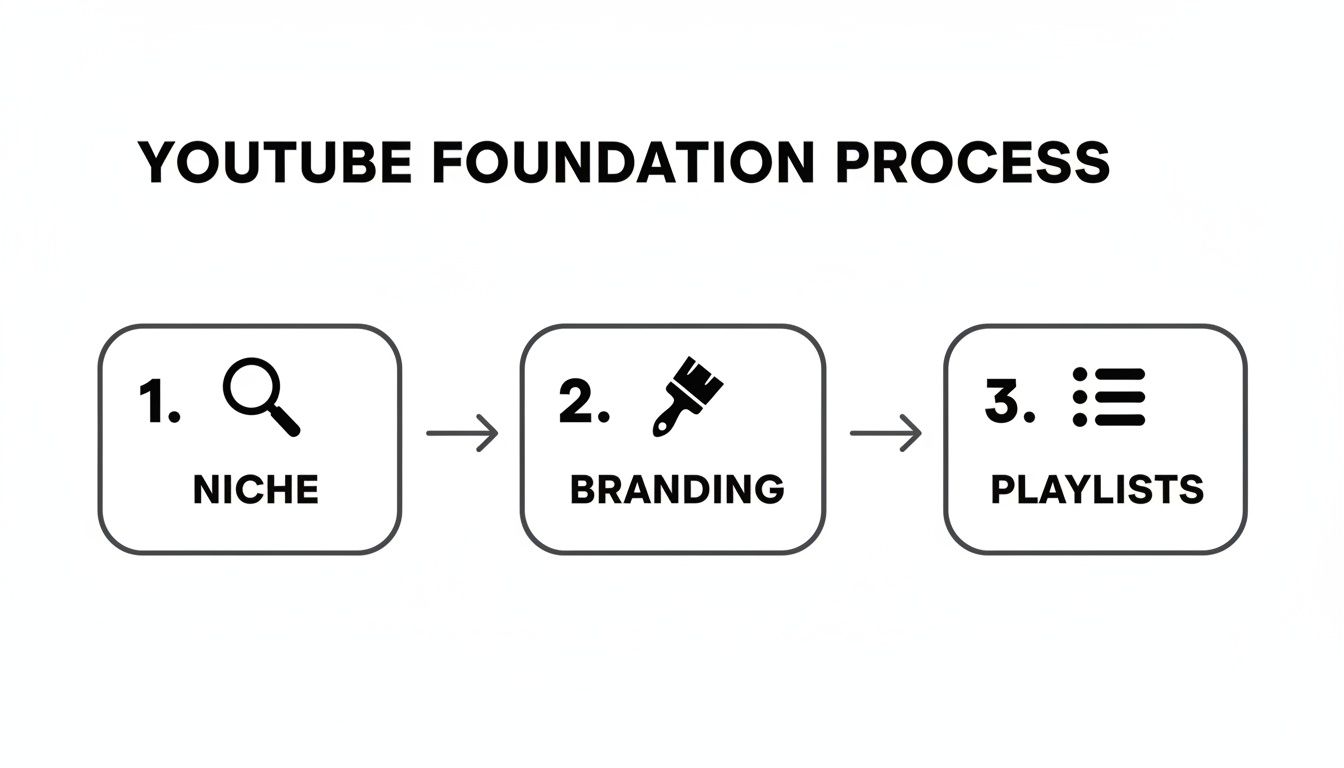
As you can see, it all starts with a focused niche, which is then brought to life by consistent branding and made easy to navigate with smart playlists.
Organise Your Content for Binge-Watching
Finally, make playlists your best friend. They guide new viewers to your best stuff. When someone lands on your channel page, they shouldn't have to go on a treasure hunt. Group your videos into logical series or categories.
Practical Example: Fitness creator Chloe Ting masterfully uses playlists like "Get Abs in 2 WEEKS" or "Hourglass Program." A new visitor immediately sees a structured workout plan they can follow, making it far more likely they'll subscribe to complete the program. This doesn't just make for a better viewer experience; it also boosts your watch time, which is a huge signal to the YouTube algorithm to push your content out to more people.
Find Video Ideas That People Are Actually Searching For
A slick-looking channel is a great start, but it won't grow on its own. The real secret to long-term growth is consistently creating videos that people are actively looking for. It’s time to stop guessing what might work and start using data to plan your content. This small shift in approach is what separates the creators who get stuck from the ones who take off.
You're essentially looking for a sweet spot: topics with high search demand but relatively low competition. When you find that gap in the market, you give your videos a fighting chance to get noticed, ranked, and ultimately, earn you those precious subscribers.
Using Data to Uncover Hidden Gems
Relying on pure inspiration is a recipe for burnout. The smartest creators use tools to see what’s bubbling up on platforms like YouTube, Google, and even Reddit. These places are goldmines of audience interest, telling you exactly what people are curious about, struggling with, and dying to watch.
Case Study: Markiplier. When the game Five Nights at Freddy's was gaining traction, Markiplier didn't just play it; he created a massive series, diving deep into its lore and secrets. By spotting a trending topic early and owning it, he tapped into a huge wave of search interest. A smaller creator could have applied this by making a video on "The easiest way to beat Night 5," serving a specific need within that massive, trending topic. You're not competing head-to-head; you're serving a niche need.
My Pro Tip: Don't just chase what's popular right now. Look at the trend data. Is interest in a topic growing, or is it on the way out? Jumping on a trend that's on an upward curve gives your video a much longer shelf life and a far greater chance of catching fire.
Validate Your Ideas Before You Hit Record
Got a list of potential video topics? Great. Now, you need to validate them. This is the step that so many creators skip, and it's often the difference between a channel that grows and one that flatlines. Using metrics like search volume and virality scores helps you focus your energy on videos that already have an audience waiting for them.
This is where a tool like Vidito comes in handy. It can show you how to find and analyse different angles on a popular topic, giving you the confidence that comes from real data.
A good dashboard will lay out the metrics for each idea, letting you quickly see which topics have the best combination of search demand and manageable competition. It transforms your brainstorming from a shot in the dark into a calculated, strategic move. You can see this process in action by checking out a Trend Angle Finder tool.
Thinking about how you currently come up with ideas? Let’s put the old way of thinking up against a more modern, data-backed method.
Idea Validation Framework Comparison
| Validation Metric | Traditional Brainstorming | Data-Driven Ideation (e.g., Vidito) |
|---|---|---|
| Source of Ideas | Based on your own interests, a gut feeling, or what "seems" popular. | Pulled from real-time YouTube, Google, and Reddit trend data. |
| Competition Check | Manually searching YouTube to see who else made a similar video. | Automated analysis of topic saturation and how many creators are active. |
| Audience Demand | A complete guess based on personal observation or what you hope people want. | Quantified with hard numbers like search volume data and virality scores. |
| Success Potential | Totally unpredictable. It's a frustrating mix of hits and misses. | A much higher probability of success because the ideas are pre-vetted. |
| Efficiency | Often time-consuming and can lead to major creative blocks. | Incredibly fast and generates a consistent stream of validated ideas. |
By bringing a data-driven mindset to your content strategy, you start building a channel that reliably gives a waiting audience exactly what it wants. Every video you make is founded on evidence, not just hope. This methodical approach is fundamental to getting more subscribers on YouTube because it ensures all your hard work actually gets in front of the right people, time and time again.
Craft Videos That Keep People Watching
So, you've got a fantastic, validated idea. That's your launchpad. But the actual structure of your video? That's the rocket fuel. If viewers bail after 30 seconds, the YouTube algorithm sees it as a red flag. It assumes your video isn't delivering, so it stops showing it to new people. The secret to gaining subscribers is mastering audience retention, and that game starts the second someone hits play.
Holding a viewer's attention is a real mix of art and science. It’s all about creating a video that respects their time while delivering on the promise you made in your title and thumbnail. This means you need to consciously engineer every part of your video, from the opening hook to the final frame, to keep them locked in.
Hook Them in the First 15 Seconds
You've got a tiny window—about 15 seconds—to convince someone your video is worth their time. This is non-negotiable. Ditch the long, slow intros and the rambling "hey guys, what's up." You have to get straight to the point and land an immediate hook.
What does a powerful hook look like?
- Ask a provocative question: "What if everything you thought you knew about saving money was completely wrong?"
- Make a shocking statement: "This one tiny mistake is costing you half your potential subscribers."
- Flash a glimpse of the end result: Before you explain how you built that incredible custom desk, show a quick, stunning shot of the finished product.
Case Study: Dream. In his Minecraft Manhunt videos, he often starts mid-chase with high-energy action. The very first second is chaotic and exciting, immediately posing a question: "How will he escape?" This hooks viewers instantly, compelling them to watch to see the outcome.
Structure Your Content for Maximum Engagement
Once you've got them hooked, your next job is to maintain that momentum. A disorganised, confusing video will have viewers heading for the exit. Instead, lean on a clear storytelling structure that guides your audience smoothly from one point to the next. Even a simple "how-to" video benefits from a narrative arc.
Case Study: Marques Brownlee (MKBHD). He reviews incredibly complex tech, yet his videos are models of clarity. He typically opens with a core problem or a key question ("Is the new iPhone really worth it?"), walks you through his meticulous testing, and wraps up with a clear, confident verdict. His flawless visuals and crisp, logical editing make even the densest topics feel effortless to follow, which is a huge reason his audience retention is so phenomenal.
Key Takeaway: Structure isn't just for film directors. A clear beginning (the hook), middle (the core value), and end (the conclusion and call-to-action) makes your content far easier to digest and much more satisfying for the viewer. That translates directly to longer watch times.
You can also use what are called "pattern interrupts" to constantly reset a viewer's attention. This just means changing something up visually or audibly every 15-20 seconds. It could be a new camera angle, a text overlay popping up on screen, a subtle sound effect, or a quick cut to some B-roll footage. For more ideas on structuring your content, check out our deep dive into making engaging YouTube long-form videos.
The Unspoken Power of Quality Audio and Visuals
Look, you don't need a Hollywood budget, but bad audio is a deal-breaker. I've seen it time and time again: viewers are far more likely to forgive slightly shaky camera work than they are to sit through scratchy, hard-to-hear audio. A decent microphone is genuinely one of the best early investments you can make for your channel.
On the visual side, think about your B-roll. This is all the supplemental footage you cut in to add context and visual spice. Practical Example: If you're a travel vlogger talking about the best coffee in Rome, don't just sit in your hotel room. Show quick, cinematic shots of steam rising from a cup, the bustling café, and espresso being poured. Good B-roll breaks up the monotony of a "talking head" shot and makes your video feel infinitely more dynamic and professional.
Design Titles and Thumbnails That Work as a Team
Your title and thumbnail have one job: to earn the click. They need to work together to spark curiosity and accurately signal what the video is about, but without giving the whole game away. Getting this right is how you boost your click-through rate (CTR), which is a massive signal to YouTube that people are interested in your stuff.
Practical Example: Look at a creator like MrBeast.
- Thumbnail: A high-contrast, expressive image showing a dramatic moment (like a giant pile of money or a shocked face). It makes you ask, "What is going on here?"
- Title: Provides the logical context: "I Spent 50 Hours Buried Alive." The thumbnail creates the emotion, and the title delivers the information. They work perfectly together.
A brilliant title and thumbnail combo is what turns a passive impression into an active view—the first and most vital step towards gaining watch time. Of course, maximising your reach is also part of the puzzle. Understanding the best times to post on YouTube can give your video a crucial initial boost, helping it attract those all-important new subscribers right from the get-go.
Turn Your Viewers into Subscribers
Views are great, but they're just a one-off. Subscribers? That’s the start of a real community. Getting someone to hit that subscribe button is a deliberate art; it rarely happens by accident. This is where you have to shift your mindset from just making content to actively building a loyal following.
So, what makes someone commit? It’s not just about liking a single video. It's about them believing you'll deliver that same value time and time again. You need to bridge that gap between a casual viewer and a dedicated fan by being direct, engaging, and consistently delivering on your promises.
Nail Your Ask
It sounds almost too simple, but one of the biggest reasons people don’t subscribe is that they just weren't asked. But there’s a right way and a very wrong way to do this. Pleading for subs in the first ten seconds, before you’ve given them anything of value, feels cheap and can really put people off.
The golden moment for your call-to-action (CTA) is right after you’ve dropped a brilliant tip or an "aha" moment. The viewer is feeling good about your content, so they're far more likely to subscribe for more of that feeling.
Practical Example: "If you found that tip on layering watercolours useful, hit the subscribe button. I'll be sharing a brand new blending technique in next week's video you won't want to miss."
See the difference? This approach ties the act of subscribing to a real, tangible benefit for them. It becomes a logical next step, not just a favour to you.
Use Visual Cues and End Screens
Don't just rely on your voice—guide your viewer's eyes. Visual prompts are incredibly powerful for reminding people to subscribe without jarring them out of the experience.
- Animated Subscribe Buttons: A subtle, well-designed pop-up that appears in the corner during a key moment can work wonders. It’s a gentle, non-intrusive nudge that backs up your verbal CTA.
- Branded Watermark: Dive into your YouTube settings and add a custom subscribe button that appears on all your videos. It's a constant, low-key reminder that's always on screen.
- End Screens: The final 20 seconds of your video are pure gold. Use YouTube’s end screen elements to add a big, clickable subscribe button right next to a suggested video. Practical Example: Watch any video from a major creator like PewDiePie; the last 20 seconds consistently feature a clear end screen prompting you to watch another video or subscribe, keeping you in their ecosystem.
These visual elements work in tandem, creating a system that consistently prompts viewers to take that next step.
Build a Community, Not Just an Audience
This is what separates the good channels from the truly great ones. People subscribe—and stay subscribed—when they feel like they’re part of something bigger. Fostering a real community turns passive viewers into active, engaged fans who feel a genuine connection to you and your channel.
Your comments section is ground zero for this. Make it a personal mission to reply to as many comments as you can, especially in the first few hours after a video goes live. When people see you’re actively reading and responding, they feel heard and valued. It flips the script from a one-way broadcast into a two-way conversation.
Case Study: LegalEagle. Creator Devin Stone is known for engaging with his comments, even pinning the most insightful or funny ones. He creates a space where viewers feel their input genuinely matters. This active participation makes subscribing feel like joining an ongoing discussion, not just signing up for content alerts. To really turn viewers into loyal fans, you have to understand how to increase YouTube subscribers and build a loyal audience.
Promote Your Content and Collaborate for Growth
Hitting ‘publish’ on a brilliant video is just the beginning. If that’s where your work stops, you’re leaving a huge amount of potential growth on the table. To really kick your subscriber count into high gear, you need to be proactive. That means pushing your content to new audiences and strategically tapping into communities that already exist beyond YouTube.
Think about it: your ideal viewer isn't just sitting on YouTube waiting for you. They're scrolling through TikTok, browsing Instagram, or deep in a Reddit thread. By meeting them where they are, you build bridges that lead them right back to your channel, bringing fresh eyes to your best work. This one-two punch of smart promotion and collaboration is what separates the channels that stall from the ones that skyrocket.
Repurpose Your Content for Wider Reach
One of the most efficient promotional tactics is to slice and dice your long-form videos into bite-sized clips for other platforms. A single 10-minute video can easily become a goldmine of content for TikTok, Instagram Reels, and YouTube Shorts.
A new viewer might hesitate to commit to a full-length video from a creator they've never seen before. But a compelling 30-second clip that grabs their attention in their feed? That's a much easier ask.
Here’s a practical workflow:
- Find the Hooks: Scan through your 10-minute video on "The Best Budget Laptops for Students" and pull out the 30-second segment where you reveal the number one pick.
- Add Context: Add on-screen text like "My #1 Laptop for Under £500" so the clip makes sense on its own.
- Point Them Home: End with a clear call-to-action. Something as simple as, “For the full list of pros and cons, watch my breakdown on YouTube – link in bio!” is all you need to direct traffic.
This isn’t just about promoting one video. It’s about building brand awareness across the board, creating a funnel that constantly brings new, interested viewers back to your main channel where they're much more likely to hit subscribe.
The Power of Strategic Collaborations
While repurposing content is a fantastic solo game, nothing moves the needle quite like a well-planned collaboration. When you partner with another creator, you’re getting a warm introduction to their entire audience—people who already trust their recommendations.
The trick is finding the right partner. You're looking for someone whose audience overlaps with yours thematically, but who isn't a direct competitor. Their channel can be a similar size or even a bit bigger, but the real key is audience alignment. A collab with someone in a totally unrelated niche just won't land.
My Pro Tip: Don't ever send a lazy "Hey, wanna collab?" message. Do your homework. Watch their videos, get a feel for their style, and pitch a specific idea that clearly benefits both of you. Make it an easy 'yes' by showing you’ve put in the effort.
A Case Study in Collaborative Growth
Let's imagine a UK-based cooking channel focused on traditional British baking. They've got a small, loyal following but have hit a growth plateau. They spot a popular food influencer on TikTok known for their quick, eye-catching recipe videos.
They pitch a collaboration: a joint video creating a modern twist on a classic Victoria sponge. The TikTokker creates a punchy 60-second Reel of the process, shouting out the YouTube channel for the full, detailed recipe. In return, the YouTuber features the influencer in their long-form video, linking to their TikTok profile in the description.
This single move exposes the baker to hundreds of thousands of engaged food lovers. A good chunk of them will click over to YouTube for the full recipe, and because they're already passionate about baking, the conversion rate from viewer to subscriber is incredibly high. It’s a perfect example of how to get more subs on YouTube by borrowing credibility and reach.
The impact of these partnerships is well-documented. To help you prioritise, here's a look at the kind of subscriber gains you can expect from different collaboration approaches.
Subscriber Growth From Different Collaboration Types
| Collaboration Type | Average Subscriber Gain |
|---|---|
| Cross-Platform (e.g., YouTube + TikTok) | +15% |
| Same-Niche (e.g., Two baking channels) | +12% |
| Guest Appearance (You appear on their channel) | +10% |
| Product/Brand Collaboration | +8% |
As the data shows, cross-platform collaborations deliver the highest subscriber boosts, with a +15% average gain. This is a massive opportunity for UK YouTubers trying to stand out among 35.6 million adult users. With the core 25-44 year old demographic making up 44% of the audience, these smart partnerships are essential. Teaming up with that TikTok influencer gets your content in front of fresh eyes that convert far faster than solo efforts ever could. You can dive deeper into these YouTube growth insights to see the full picture.
Use Analytics to Drive Your Content Strategy
Growing a YouTube channel isn't about blind luck or chasing a one-off viral hit. It's a game of inches, won by making smart, data-informed decisions day in and day out. Think of your YouTube Analytics dashboard as your secret weapon; it’s a direct line into your audience's mind, showing you exactly what’s working and what’s falling flat.
Learning to read this data is what separates the creators who stagnate from those who build a loyal following. It transforms your content creation from a guessing game into a repeatable process for success, allowing you to refine your strategy with precision and position every video for growth.
Key Metrics That Actually Matter for Growth
When you first dive into YouTube Analytics, it's easy to get lost in a sea of graphs and numbers. The trick is to ignore the vanity metrics and zoom in on the data that directly influences subscriber growth.
Here’s what you should be keeping a close eye on:
- Audience Retention: This graph is pure gold. It shows you the precise moment viewers are clicking away. Practical Example: If you see a big drop at the 2-minute mark in all your videos, that might be where your long, branded intro plays. The data is telling you to shorten or remove it.
- Click-Through Rate (CTR): This is a simple measure of how many people clicked on your video after seeing it. A low CTR (typically under 4%) is a huge red flag that your thumbnail or title isn't compelling enough.
- Subscribers by Video: This is your North Star. In the "Advanced Mode" of your analytics, you can see which specific videos are bringing in the most subscribers. This isn't just a nice-to-know stat; it's a direct instruction from your audience about what they want to see more of.
These three metrics are locked in a feedback loop. A killer CTR gets people in the door, high audience retention keeps them watching, and genuinely great content convinces them to subscribe.
Pinpoint Your Subscriber-Winning Content
Once you've identified your "subscriber magnets," the real work begins. Don't just pat yourself on the back; it's time to play detective. Go back and re-watch your top-performing videos with a critical eye.
Ask yourself some specific, granular questions:
- What was the exact topic? Was it a deep-dive tutorial, a quick-and-dirty review, or a personal vlog?
- What did the thumbnail look like? Did I use bold text, a specific colour palette, or an expressive reaction shot?
- How was the video structured? What was the hook, how did I keep the pace up, and where did I place my edits?
- What did I actually say when I asked people to subscribe? Was it at the start, middle, or end?
By spotting the common threads across your most successful content, you can start building a playbook. This isn't about copying yourself; it's about creating a proven formula that consistently attracts new, loyal subscribers.
A Real-World Case Study: A tech creator I worked with noticed two of his videos on "budget gaming laptops" had brought in 40% of his new subscribers over the past month. Meanwhile, his slickly produced videos on high-end monitors were getting views but almost no new subs. The data was screaming at him: his audience was hungry for value-focused content. He immediately pivoted, doubling down on budget peripherals and PC builds, and his channel growth exploded.
Run A/B Tests to Optimise Everything
Analytics isn't just about looking back; it’s your roadmap for the future. You can run simple experiments, known as A/B tests, to fine-tune everything from your thumbnails and titles to your video formats. The process is simple: change one thing at a time and measure the impact.
Practical Example: You have a video titled "How to Edit Videos Faster." You could test two thumbnails:
- Thumbnail A: Shows a picture of your video editing software timeline.
- Thumbnail B: Shows your face with a shocked expression next to a stopwatch that says "5 MINS!"
After a week, you compare the CTR for both. The data will reveal a clear winner, giving you a tangible insight to apply to all future uploads.
This methodical approach is crucial. In the UK alone, YouTube has over 35.6 million adult users, with the 25-44 age group being the most active. But the competition is fierce—less than 0.4% of channels worldwide ever hit 100,000 subscribers. A data-driven strategy isn't a "nice-to-have" anymore; it's essential for carving out your piece of this massive audience. You can dig deeper into the UK's YouTube landscape to see just how big the opportunity is.
Ready to stop guessing and start creating videos you know have potential? Vidito uses AI to analyse real-time data from YouTube, Google, and Reddit, giving you validated video ideas with proven search demand. Know how successful your video can be before you even hit record. Start generating click-worthy ideas for free at https://vidito.ai.