The Ultimate Guide to Making Long YouTube Videos
In the bustling world of content creation, a long YouTube video is much more than just a video that runs past the 10-minute mark. It’s a deliberate, strategic choice aimed at creating a deep connection with your audience. Think of it like the difference between a catchy pop single and a full, immersive album. Both have their place, but the album tells a richer, more complete story.
What Defines Long YouTube Videos Today

The very idea of what's "long" on YouTube has shifted dramatically over the years. Not too long ago, a seven or eight-minute video felt like a significant piece of content. Fast forward to today, and you'll find successful creators regularly pushing out videos that are 20, 40, or even over 60 minutes long. This isn't about rambling on to fill time; it's a calculated move to deliver immense value.
This evolution was partly nudged along by YouTube itself. When the platform enabled mid-roll ads on videos longer than 10 minutes (now 8 minutes), it created a clear financial reason for creators to go deeper and produce more extensive content. That single change reshaped the entire creator ecosystem, encouraging longer, more substantial videos.
The Strategic Shift Beyond the Clock
What really defines a modern long-form video isn't the number on the clock, but its purpose. These videos are crafted to be the ultimate resource on a given subject, cementing the creator's position as a go-to expert in their field.
So, instead of just focusing on duration, a truly effective long-form video is characterised by:
- In-depth Exploration: It dives far below the surface to provide detailed analysis, showcase multiple viewpoints, or walk viewers through a comprehensive tutorial. A practical example is Nerdwriter1, whose video essays often exceed 15 minutes to fully deconstruct a film scene or artistic concept.
- Community Building: These videos act as a shared journey, forging a powerful bond between you and your most dedicated viewers. Think of MrBeast's longer challenge videos; the length allows viewers to feel like they are part of the experience.
- Algorithmic Advantage: Longer videos are perfectly designed to accumulate watch time, which remains one of the most powerful signals you can send to the YouTube algorithm to get your content recommended.
This strategy has been taken to some wild extremes. The longest video ever uploaded, for example, was a mind-boggling 571 hours long by Jonathan Harchick, who had to become an expert in video compression just to get it on the platform. While that’s certainly not the goal, it shows that YouTube is built to handle content far beyond what we think of as standard, as you can discover in these UK YouTube statistics.
A Practical Example of Long-Form Success
Let's look at a real-world example: the tech creator Marques Brownlee, better known as MKBHD. His detailed tech reviews consistently push past the 20-minute mark. His video, "The Problem with Foldable Phones!", is a perfect case study, running for nearly 18 minutes. He uses that time to explore everything from engineering hurdles to the real-world user experience and future market trends.
By dedicating this much time, he doesn't just review a product; he educates his audience and solidifies his reputation as a leading voice in the tech community. A shorter video simply couldn't achieve the same level of authority or detail.
Why the YouTube Algorithm Loves Watch Time
To really get why long YouTube videos can be so powerful, you have to put yourself in YouTube's shoes. What’s its number one goal? It’s simple, and it never changes: keep people on the platform for as long as humanly possible. Every single feature, from the videos on your homepage to that "Up Next" sidebar, is fine-tuned to maximise this session time.
When your video helps YouTube achieve that goal, the algorithm sees it as a valuable asset. It rewards you by pushing your content out to a much wider audience, kicking off a fantastic feedback loop of more views and faster growth. This is precisely where longer videos have a massive edge.
Total Watch Time Is King
So many creators get hung up on their audience retention percentage. And look, a high percentage is great, but it’s not the whole picture. The metric that truly moves the needle is Total Watch Time – the grand total of all the minutes people have spent watching your video.
Let's make this crystal clear with a quick example:
- Video A: A 5-minute vlog with an amazing 80% audience retention. That means the average viewer sticks around for 4 minutes.
- Video B: A 30-minute documentary with a solid 40% audience retention. Here, the average viewer watches for 12 minutes.
Even though its retention percentage is half that of the vlog, Video B racks up three times more watch time per viewer. That sends a much, much stronger signal to the algorithm that your content is doing a brilliant job of keeping people engaged and on the site.
Case Study: MKBHD and Topical Authority
If you want to see a creator who has this down to a fine art, look no further than Marques Brownlee, or MKBHD. His channel is an absolute masterclass in creating in-depth tech reviews that often sail past the 20-minute mark.
Just take a glance at his channel, and you'll immediately notice the significant length of his main videos.
It’s obvious that his biggest videos are consistently longer than 10 minutes, with many pushing 20. This shows a clear strategy built around comprehensive, long-form content.
By consistently putting out these detailed, high-quality reviews, MKBHD achieves two crucial things. First, he generates a colossal amount of watch time with every single upload. Each video becomes a huge boost to YouTube’s session time goals, which naturally earns his content preferential treatment from the recommendation engine.
Second, this approach builds incredible topical authority. When you constantly produce the most thorough and detailed videos on a given subject, the algorithm starts to see your channel as the definitive source for that entire niche.
This authority means his new videos have a much better chance of ranking high in search and being recommended alongside other popular tech content. He's not just making one-off videos; he's building a whole library that screams to YouTube, "I'm the go-to expert for tech analysis."
At the end of the day, making longer videos isn't just about padding for time. It's a strategic move to align your channel directly with YouTube's core mission. By focusing on generating serious watch time, you prove your value to the algorithm, which paves the way for greater visibility, authority, and sustained channel growth.
How to Structure a Video People Actually Finish
Just hitting record and talking for an hour is a surefire way to watch your audience retention graph plummet. The real magic behind successful long YouTube videos has nothing to do with the clock; it's all about the structure. A solid narrative plan is the difference between a 40-minute documentary that has viewers glued to the screen and a rambling monologue they’ll click away from in five minutes flat.
The most reliable framework for keeping people invested is the classic ‘Hook, Build, Payoff’ model. It’s a simple but incredibly powerful storytelling arc that gives your video momentum and a clear sense of direction, leading your audience from initial curiosity right through to a feeling of satisfaction. Getting this right is fundamental to keeping them watching.
Craft an Irresistible Hook
You’ve got about 30 seconds. That’s it. In that tiny window, you have to convince someone that your video is worth their time. This opening, the Hook, has to be magnetic, promising a clear benefit or the solution to a problem they’re facing. Please, don't waste these crucial seconds with a long, generic intro or a flashy branding animation that nobody asked for.
Cut straight to the chase. Kick things off with a challenging question, a jaw-dropping statistic, or a bold statement about the value they’re about to receive. By teasing the final result or the most fascinating part of the video, you create an "information gap" that their brain will desperately want to close by sticking around to see what happens next.
A great practical example comes from Mark Rober. Many of his videos start by immediately showing the incredible final result of his engineering project (like a giant squirrel obstacle course), before saying "so, how did we get here?" This hooks viewers instantly, making them stay to see the process.
Strategically Build Momentum
The Build is where you make good on the promise you made in your hook. This is the main body of your video, and for longer content, it needs to be organised with military precision to stop viewers from getting bored and wandering off. The goal here is to create a sense of escalating tension or deliver progressively more valuable insights to keep them locked in.
This is where YouTube's chapters feature becomes your best friend. Breaking your video down into logical, timestamped segments is like giving your viewer a roadmap. It makes a long video feel far less daunting and lets them jump to the bits they're most interested in, which, believe it or not, actually helps increase your total watch time.
It’s all about feeding the algorithm what it wants: watch time. The more of it you get, the more your video gets recommended.
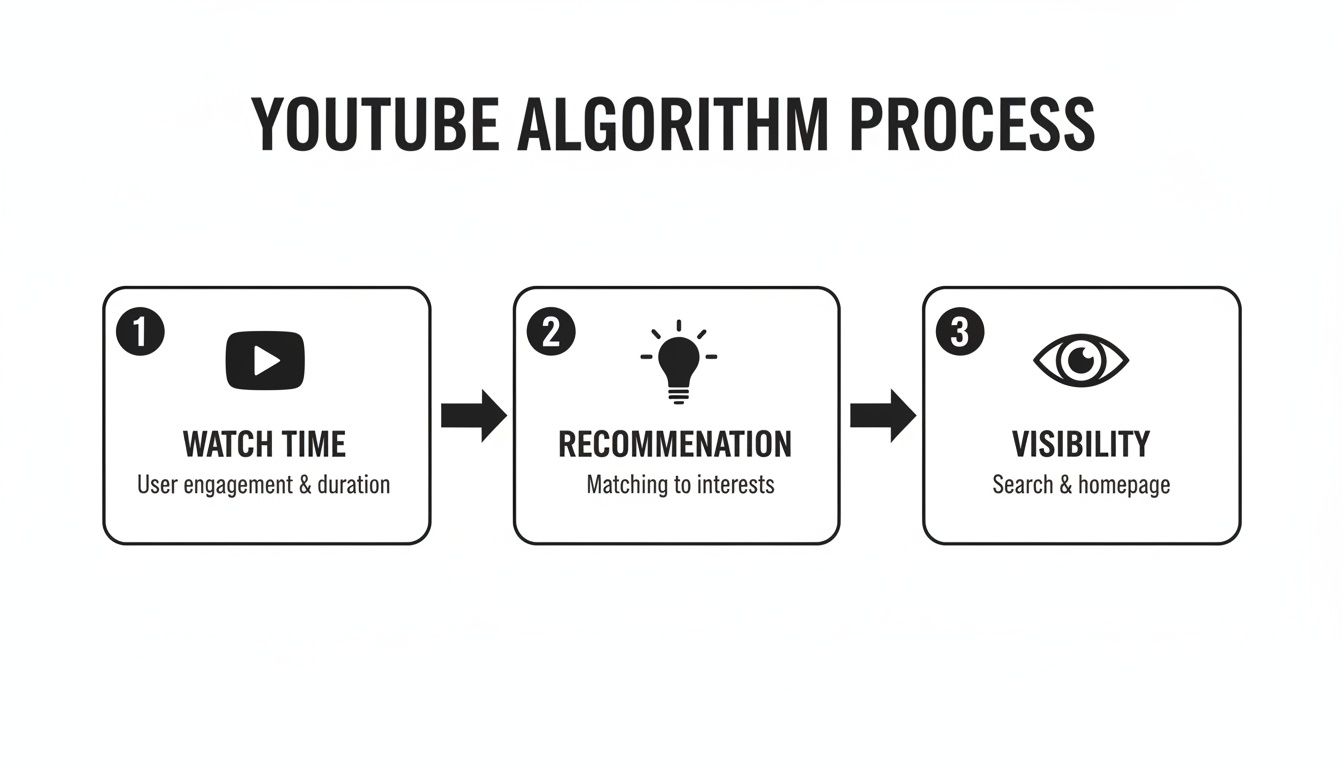
As you can see, the relationship is direct. More watch time sends a powerful signal to YouTube, telling it to push your video out to a wider audience.
Deliver a Satisfying Payoff
Finally, we arrive at the Payoff. This is your video’s conclusion, where you reveal the final answer, show off the finished project, or wrap up the most important takeaways. A strong payoff gives the viewer a sense of closure and makes them feel like their time was well spent.
This is your chance to really seal the deal and even exceed their expectations. A weak, rushed, or abrupt ending can leave a bad taste, ruining the entire experience, no matter how brilliant the rest of the video was. A truly satisfying conclusion reinforces all the value you’ve provided and is what motivates viewers to hit the like button, subscribe for more, and check out what else you’ve made.
Case Study: LEMMiNO's Documentary Structure
If you want to see a master at work, look no further than the channel LEMMiNO. His video "The Search for D. B. Cooper" is over 45 minutes long, yet his audience retention is phenomenal. Here’s how he does it:
- Hook: He doesn't mess about. He dives straight into the core mystery, laying out the bizarre and compelling facts of the skyjacking incident within the first 60 seconds. You’re immediately hooked.
- Build: Using clear chapters, he methodically works through the different suspects and theories. Each section builds upon the last, adding new layers of evidence and intrigue that pull you deeper into his investigation.
- Payoff: The ending isn't just a summary. He thoughtfully weighs the most plausible theories and leaves the viewer with a final, lingering reflection on the mystery. It’s a masterful conclusion that provides a deeply satisfying narrative resolution.
By sticking to this structure, LEMMiNO takes a dense, complex topic and turns it into an absolutely gripping documentary experience.
Filming and Editing for Maximum Engagement
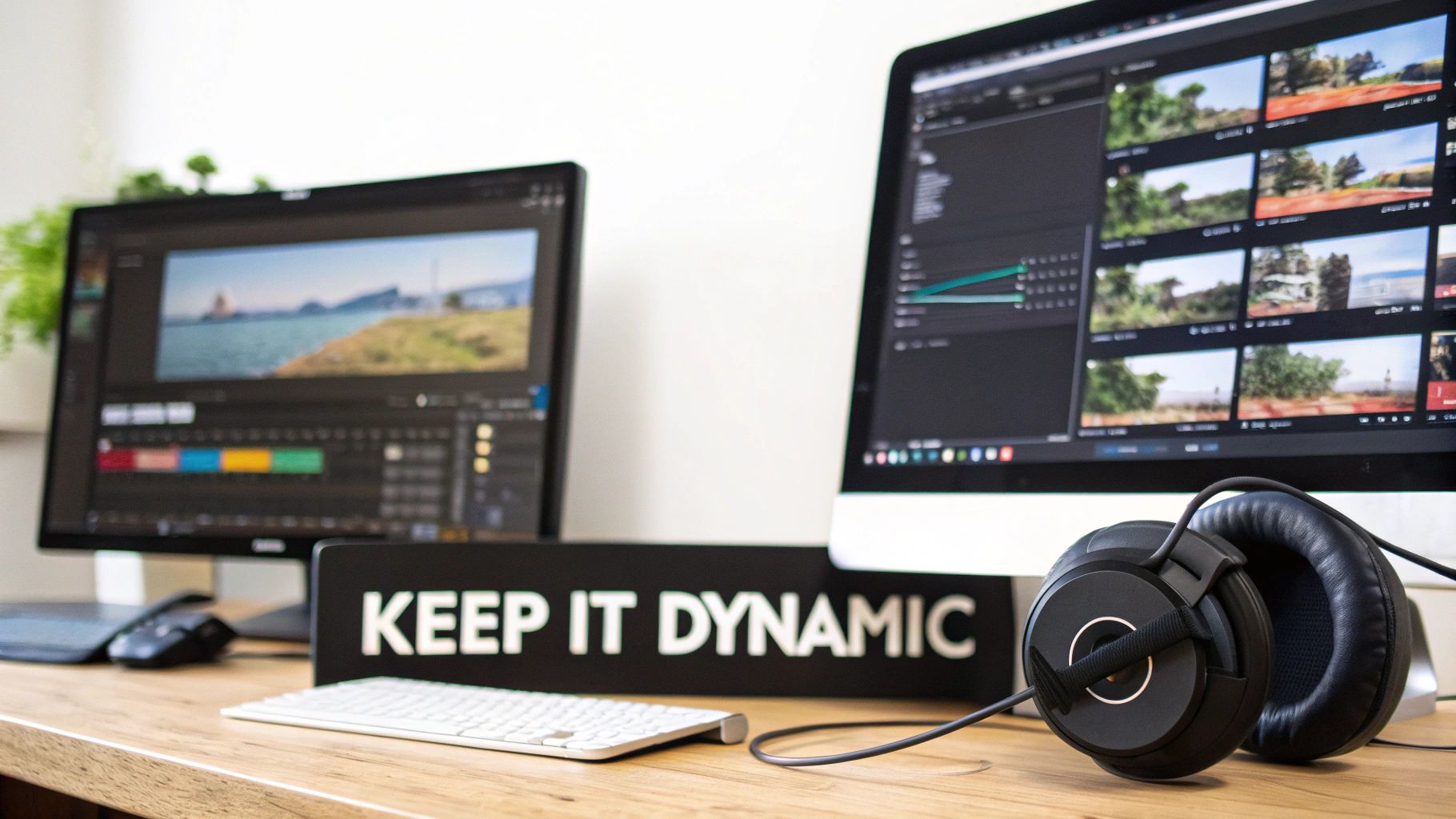
A fantastic script or outline is a great start, but it's only half the battle. If you want to keep people watching a long video, the way you film and edit has to be just as dynamic as the information you're sharing.
Think of it like a long road trip. Even the most stunning scenery can get boring if the journey feels monotonous. You need interesting stops, changes in speed, and different views to keep it fresh. In video, your filming and editing choices are what prevent viewer fatigue.
The real secret sauce here is something called pattern interrupts. These are small, frequent changes to what the viewer is seeing or hearing that constantly reset their attention. The human brain is hardwired to notice change, so by sprinkling it throughout your video, you stop your audience from zoning out—even during a 30 or 40-minute deep dive.
The Power of Pattern Interrupts
Don't worry, these interruptions don't have to be complicated or dramatic. Their power comes from consistency. The aim is to introduce a subtle shift every 15-20 seconds to keep the experience feeling active and alive. It's the difference between a static lecture and an engaging, interactive presentation.
Here are the essential techniques you should have in your toolkit:
- Jump Cuts: A classic for a reason. Simply cutting forward in time to snip out pauses, breaths, or "ums" and "ahs" instantly injects energy and tightens up the pace.
- B-Roll Footage: This is your visual evidence. If you’re talking about a specific tool, show it in action. Discussing a location? Show clips of that place. It brings your words to life.
- On-Screen Graphics: Text callouts, animated icons, or simple diagrams are fantastic for hammering home key points and making your information easier to digest.
- Zooms and Pans: A slow push-in can add emphasis and intimacy to a critical point. A quick "punch-in" can add a touch of humour or jolt the viewer's attention.
- Sound Effects: Never underestimate the power of audio! A subtle whoosh as a graphic appears or a soft click when highlighting text can make your video feel incredibly polished and professional.
When you weave these elements together, you create a viewing experience that’s stimulating enough to maintain high retention on longer videos. To get started, you'll need the right editing suite. You can explore some great options in our guide on the best software for editing videos for YouTube.
Case Study: Emma Chamberlain's Editing Style
For a masterclass in using pattern interrupts to make everyday content completely mesmerising, look no further than Emma Chamberlain. She practically reinvented the vlogging format with a style that feels chaotic but is actually incredibly deliberate. She can make a 20-minute video of herself making coffee feel like a gripping adventure, all thanks to her editing.
Her videos are a relentless barrage of quick zooms, jarring jump cuts, and quirky text on screen. While that specific, high-energy style won't fit every niche, the core principle is universal: constant visual and auditory change keeps the viewer glued to the screen.
She’s proof that you don't need a Hollywood budget to hold an audience. By mastering basic editing techniques to create a dynamic rhythm, she turns the mundane into must-watch content.
Mastering Your Video's Pacing
Pacing is the rhythm of your video, and it's one of the trickiest things for new creators to get right. It’s all about knowing when to hit the accelerator and when to slow down and let a moment breathe. A common mistake is to keep the energy at 100% with non-stop fast cuts for an entire video, which can be just as tiring for a viewer as a video that’s too slow.
Try to think about your video’s rhythm like this:
- Accelerate Through the Setup: When you're giving background information or context, use quicker cuts and more b-roll to move things along and get to the core value proposition.
- Decelerate for Key Moments: When you hit that crucial "aha!" moment or a complex detail, slow everything down. Use longer takes, hold the shot, and reduce the cutting to signal to your audience: "Pay attention, this part is important."
- Vary the Flow: The real magic is in the contrast. By mixing quick, energetic sections with slower, more deliberate ones, you create a compelling rhythm that makes even a long video feel shorter and more engaging.
Driving Revenue and SEO with Long-Form Content

Longer videos are so much more than just content; they're powerful business assets. When you keep viewers engaged for longer, you open up a whole new world of sophisticated monetisation and SEO strategies that just aren't on the table with shorter clips. It's how you can turn your channel from a creative passion into a genuinely sustainable business.
The most obvious route to making money is through YouTube's own ad system. Longer videos give you the space to place multiple mid-roll ads. Of course, there's a fine line to walk—you don't want to ruin the viewing experience—but more ad slots mean more potential earnings from a single video. It's simple maths.
This is particularly relevant in markets like the UK, where audiences have a real appetite for in-depth video. In 2024, British viewers are spending an average of 39 minutes a day on YouTube, and TV sets have become the go-to device for watching. This creates a huge opportunity for creators who can capture that dedicated audience with well-structured, ad-supported long-form content. You can find more on this trend and how YouTube became the second most-watched video platform in the UK.
Expanding Beyond Ad Revenue
Let's be honest, relying entirely on AdSense can be a rollercoaster. Long videos provide the perfect canvas to diversify your income and build more stability through integrated promotions.
- Deeper Affiliate Integrations: Instead of a fleeting mention, a long tutorial allows you to properly demonstrate and review several affiliate products, showing their value in a practical context. Peter McKinnon, a photography creator, does this masterfully in his 20+ minute videos, where he'll spend several minutes genuinely using and explaining a product like a camera bag or a filter, making the affiliate pitch feel earned and valuable.
- High-Value Product Promotion: The authority you build over a 30-minute video makes it the perfect moment to introduce your own courses, e-books, or other high-value digital products.
- Seamless Sponsorships: A longer runtime means you can weave brand sponsorships into your content creatively, making them feel like a natural fit rather than a jarring interruption.
When you dedicate more screen time to these opportunities, you build a much stronger case for each product or service. This almost always leads to better conversion rates and a healthier bottom line for your channel.
Turning One Video into an SEO Powerhouse
The search engine optimisation benefits of long YouTube videos are probably their most overlooked superpower. With the right approach, one comprehensive video can become an evergreen traffic machine, ranking for dozens of different search terms. The secret? Keyword-rich video chapters.
Chapters break your video down into timestamped, titled sections. Both YouTube and Google read these titles, essentially treating each chapter like its own mini-video. This is what allows a single long video to pop up in search results for a huge variety of specific, long-tail keywords tied to each segment.
Case Study: The Sourdough Guide
Imagine you create a 45-minute video called "The Ultimate Sourdough Guide for Beginners." By breaking it down with clear, descriptive chapters, you can pull in a massive range of search traffic.
- Chapter 1 (00:00): "How to Create a Sourdough Starter from Scratch"
- Chapter 2 (12:30): "Perfect Sourdough Starter Feeding Schedule"
- Chapter 3 (25:10): "Choosing the Best Flour for Sourdough"
- Chapter 4 (38:45): "Baking Your First Sourdough Loaf"
Suddenly, your one video can rank when people search for any of those specific phrases. This multi-ranking ability makes your content incredibly efficient. To really get the most out of this, a solid transcription strategy is essential; this helpful Content Creator Transcription Guide can walk you through it. By optimising your chapters and descriptions with the right terms, you make your content work smarter, not just harder. For extra help, take a look at our guide on the best YouTube keyword research tools to find these golden-ticket phrases.
Common Questions About Making Long YouTube Videos
Diving into long-form content for the first time? It's totally normal to have a few questions buzzing around. Making the switch can feel like a big step, so let's tackle some of the most common worries creators have. Think of this as your friendly Q&A to help you get started with confidence.
What’s the Perfect Length for a Long YouTube Video?
This is the big one, but the answer is surprisingly simple: there isn't a magic number. The "perfect" length is whatever time you need to explore your topic thoroughly, without padding it out with fluff.
A complex software tutorial could easily justify a 45-minute runtime, while a thought-provoking video essay might land its punch perfectly in 25 minutes. The clock is secondary to the value you provide. Your goal should be to make every minute essential. A good starting point is to scope out what’s working for others in your niche, but ultimately, respect the viewer's time and make it count.
Will Longer Videos Put Off My Current Subscribers?
It’s a valid concern, but you’d be surprised. If you handle the shift with a bit of strategy, your audience will likely come along for the ride. The key is not to spring a random 40-minute epic on them without warning. You need to bring them into the process.
Here’s how to ease them in:
- Give Them a Heads-Up: Tell your community you’re going to try making some deeper, more detailed videos. Frame it as an exciting evolution for the channel.
- Pick a Winner for Your First Go: Base your first long-form video on a topic you know your audience is desperate for. A highly requested subject almost guarantees a warm welcome.
- Don't Go All-In at Once: Try mixing it up. Alternate between your classic length and the new, longer format to give everyone something to enjoy.
Keep a close eye on your analytics, especially Audience Retention. The comments section will also be a goldmine of feedback, telling you exactly how your community is feeling.
How Can I Possibly Keep People Watching for Over 30 Minutes?
This is where the real craft comes in. Holding someone's attention for that long is a skill, blending smart planning with creative editing.
Before you even think about hitting record, map out your video's structure. Think of it like a story with a clear beginning, middle, and end. Use YouTube chapters to break the journey into smaller, manageable segments.
In the edit, your secret weapon is the pattern interrupt. These are tiny, frequent changes that reset a viewer’s focus before it has a chance to wander. Think quick zooms, switching camera angles, adding a sound effect, or popping up a graphic. A small change every 15-20 seconds is enough to keep the energy up and stop the video from feeling flat.
One long video can often rack up more total watch time than several shorter ones combined. For the YouTube algorithm, that’s a massive thumbs-up, showing that your content is brilliant at keeping people on the platform.
Think about it this way: a single, comprehensive "Complete History of Ancient Rome" video can become the go-to resource on the topic, pulling in views for years. On the other hand, a series on learning a new skill might be better for building a loyal, returning audience. It all comes down to what you want that specific piece of content to achieve.
Ready to stop guessing and start creating video ideas with viral potential? Vidito uses AI and real-time data to generate dozens of concepts tailored to your channel, complete with search volume and trend analysis. Find your next hit video idea today at vidito.ai.