How to Get More Subs on YouTube A Playbook for Real Growth
If you want to get more subscribers on YouTube, it really boils down to one core idea: define a specific niche and then consistently deliver real value to that audience. Forget chasing a one-off viral hit. The goal is to build a channel that people feel compelled to come back to, time and time again.
Building Your Foundation for Subscriber Growth

Long before you even think about hitting that record button, the most crucial work happens. A loyal subscriber base is built on a solid strategy, and that strategy starts with nailing your channel's identity. So many aspiring creators fall flat because they try to be everything to everyone. The result? A confusing mess of videos that fails to build any kind of dedicated community.
Your first job is to carve out your corner of YouTube. This isn’t about picking a massive topic like "gaming" or "cooking." It's about drilling down into a sub-niche where you can genuinely become the go-to expert. For instance, instead of just "cooking," you might specialise in "30-minute vegan meals for busy UK families." Or instead of "gaming," you could focus on "speedruns of classic SNES games."
This laser-focused approach means your content will deeply resonate with a passionate audience, making their decision to subscribe a total no-brainer. Before you lock anything in, be honest with yourself and ask these questions:
- Passion: Can I come up with 100 video ideas on this topic without losing my mind or getting bored?
- Audience: Is there a real community out there already looking for this kind of content?
- Uniqueness: What's my unique angle? What perspective can I offer that nobody else is?
Define Your Channel's Promise
With your niche sorted, it's time to define your value proposition. This is the promise you make to every single person who clicks on one of your videos. What will they get by subscribing to you? Will they learn a skill, be entertained, or stay up-to-date on a specific subject?
A clear value proposition acts like a magnet, pulling in your ideal subscribers while pushing away casual viewers who probably wouldn't stick around anyway. To really get this right, it helps to understand the fundamentals of how to start content creation in the first place.
Case Study: Ali Abdaal
Look at the trajectory of Ali Abdaal, a UK creator who began by making videos about studying for medical school. His initial niche was incredibly specific: helping students ace their exams. The value was crystal clear—watch his videos, become a better student.
As his channel exploded, he was able to gradually expand into broader topics like productivity and entrepreneurship. But that entire empire was built on a foundation of serving a very specific need for a very specific audience. It worked because his content always delivered on its promise, converting a huge percentage of viewers into loyal subscribers.
This focused strategy is absolutely essential. In the crowded UK YouTube scene of 2025, a tiny fraction—only about 0.4% of all active channels—ever hit that 100K subscriber milestone. With giants like the Sidemen and KSI dominating the entertainment space, a specialised niche is your best shot at cutting through the noise. Getting this foundation right is your first step toward joining that small percentage. If you're starting from scratch, our guide on https://www.vidito.ai/blog/setting-up-a-youtube-channel can walk you through the initial setup.
Generating Video Ideas That Actually Work
Alright, you’ve nailed down your niche. Now comes the real grind: consistently coming up with video ideas that people will actually click on and watch. This isn't just about brainstorming what you find interesting. The secret sauce is a smart mix of two very different, but equally powerful, types of content: viral and searchable.
Think of searchable content as the bedrock of your channel. These are your "how-to" guides, your tutorials, your problem-solving videos. They're the answers to questions people are actively typing into the YouTube search bar, day in and day out. A video like "How to Replace a Laptop Battery" or "Best Budget Microphone for Streaming" can pull in steady, targeted views for months, sometimes even years.
Viral content is the complete opposite. It’s your rocket fuel. These are the videos built for broad appeal, tapping into hot trends, funny formats, or pure entertainment to break out beyond your core audience. They’re your lottery tickets for those huge, sudden spikes in views and subscribers.
Finding the Sweet Spot: Mixing Search and Virality
Here’s where a lot of creators go wrong: they focus on just one.
If you only make searchable videos, your growth will likely be slow and steady. Predictable, but you'll miss out on those game-changing moments of explosive growth. On the other hand, if you only chase viral trends, you might get big view counts, but you’ll struggle to build a loyal community. People show up for the trend, not for you, and they'll leave just as quickly.
The magic happens when you blend them. A searchable video might bring a new viewer to your channel because they had a specific problem. But then, a related viral-style video of yours gets recommended, showcasing your personality and entertainment value. That's what makes them hit the subscribe button.
Case Study: Linus Tech Tips Look at a massive tech channel like Linus Tech Tips. They masterfully combine deep-dive, searchable hardware reviews (e.g., "RTX 4090 Review - It's Everything We Wanted!") with absurdly entertaining projects like building a solid gold Xbox controller. The reviews build their authority and bring in viewers with specific problems, while the viral projects create a unique brand and attract millions of new people to the channel.
Stop Guessing and Start Validating Your Ideas
Ideation should never be a shot in the dark. In today's crowded space, data is your best friend. This is where you can lean on AI-powered tools like Vidito to turn your rough ideas into validated concepts before you even think about hitting record.
Instead of just going with your gut, these platforms dig into real-time data from YouTube, Google Trends, and even Reddit conversations. They show you what people are actually looking for and buzzing about, then give you the hard numbers on your ideas.
- Search Volume: How many people are actually searching for this?
- Competition: Is this topic already oversaturated?
- Virality Score: What’s the likelihood of this idea taking off?
This is what it looks like to have validated ideas handed to you, with the key metrics right there.
Having this data means you can confidently prioritise the ideas with the highest chance of success. It saves you from pouring hours into filming something nobody was ever looking for in the first place.
How to Ride a Trend the Right Way
Jumping on trends is a classic way to get more subs on YouTube, but you have to be smart about it. The UK’s biggest channels, like the Sidemen and KSI, are masters of this. They weave gaming and pop culture trends into their content, which gives them a massive global reach.
While it’s true that a tiny fraction of channels (just 0.4%) ever hit the 100,000 subscriber milestone, strategically using trends is a common thread among those who do. For creators in any niche, from tech to cooking, tools like Vidito can automatically spot these rising trends and suggest unique angles. This gives you a fighting chance to capture that momentum. You can learn more about this strategy in our guide to the Trend Angle Finder.
By 2025, YouTube’s user base is projected to hit an incredible 2.70 billion. The competition is only getting tougher. A data-first approach isn't a luxury anymore; it's a necessity for real growth. Analysing trends across YouTube, Reddit, and Google gives you an undeniable edge, scoring your ideas on their viral potential so you know the odds before you ever pick up the camera. For a deeper dive, check out this great analysis on YouTube's evolving creator landscape.
Optimising Your Videos for Maximum Discovery

Look, you can make the most incredible video in the world, but if the YouTube algorithm can't figure out what it’s about, it might as well be invisible. This is where getting your head around YouTube SEO really pays off. It's the difference between a video that sits there gathering dust and one that YouTube actively pushes out to new viewers.
Think of SEO as a direct conversation with the algorithm. You're simply feeding it the right signals so it can match your video with the people who are actually looking for it—the ones who are most likely to watch, enjoy, and hit that subscribe button.
Crafting Titles That Work for Humans and Robots
Your title has to do two things at once: it needs to grab a real person's attention, and it needs to contain the keywords they’re typing into the search bar. So many creators get this wrong, either stuffing it with robotic keywords or making it so vague the algorithm has no idea what to do with it.
The sweet spot is a title that feels natural but is built around a solid keyword.
- Bad Title: My New Camera is Awesome! (What camera? No one is searching for this.)
- Good Title: Sony A7IV Review: 6 Months Later (Is It Still Worth It?) (This is perfect. It has the main keyword, sparks curiosity, and targets a specific search.)
Getting this right means you show up in search results and you give people a compelling reason to click. And on that note, remember that discoverability also depends on keeping your channel in good standing. It’s worth learning how to avoid copyright strikes on YouTube so your hard work doesn't get taken down.
Writing Descriptions That Feed the Algorithm
The video description is probably the most underused piece of real estate on YouTube. It's painful to see creators just dump a few links and leave it at that. This is a massive missed opportunity because the algorithm literally reads your description to understand your video's context.
The first 2-3 sentences are pure gold. Write a quick summary of the video here, making sure to weave in your main keywords naturally. This is what people see before they click "show more," and it has a big impact on your ranking.
Below that, you can really flesh things out. Use this space to:
- Add more detail about what the video covers.
- Pop in some timestamps so viewers can jump to the good bits.
- Link to other relevant videos on your channel to keep people watching.
- Sprinkle in some secondary keywords that didn't fit in the title.
This gives YouTube a ton of extra data, helping it recommend your video to a much wider, more qualified audience.
The Art and Science of Thumbnails
Let's be blunt: your thumbnail is your video's billboard. In a sea of endless content, it has a split second to convince someone to click. A great thumbnail telegraphs the video's topic and emotion instantly.
Just look at MrBeast. His team obsessively tests dozens of thumbnail options to find the one with the highest click-through rate (CTR). You might not have a whole team, but you can absolutely apply the same thinking. His signature style—often featuring a high-emotion facial expression, bright colours, and a simple, compelling visual story—is a masterclass in grabbing attention.
A killer thumbnail and a strong title are an unstoppable combination. If you can bump your CTR from 4% to 8%, you've just doubled your video's initial traffic without changing a single frame of the content itself. More clicks tells the algorithm your video is a winner, leading to more impressions and, you guessed it, more subscribers.
Focus on clear, high-contrast images, expressive faces (if it fits your niche), and big, bold text that you can read on a tiny phone screen. Check out what the top channels in your space are doing. What colours, fonts, and layouts are working for them? Analyse their success and then develop your own distinctive style.
Demystifying Video Tags
Tags aren’t the be-all and end-all they once were, but they still have their place. They're a good way to give YouTube a final bit of context, especially if your title or description contains words with double meanings.
A smart tagging strategy is all about variety.
- Specific Tags: Your main keyword should always be your first tag (e.g., "Sony A7IV review").
- Broad Tags: Add some wider category tags next (e.g., "camera review," "mirrorless cameras").
- Alternative Tags: Think about other ways people might search for your topic (e.g., "Sony A7 IV test," "A7IV footage").
Don't go overboard. A tight list of 5-10 super-relevant tags is way better than a list of 50 random ones. If you're struggling for ideas, there are plenty of YouTube keyword research tools out there to help you find what people are actually searching for. This methodical approach is what separates the channels that grow from the ones that get stuck.
Turning Viewers Into Subscribers
Getting a view is great, but it’s a fleeting moment. A subscriber, on the other hand, is a commitment—an invitation for them to come back for more.
The real secret to converting a casual viewer into a loyal fan often boils down to how you handle the first few seconds and the final moments of every single video. A simple "please subscribe" just doesn't cut it anymore. People need a genuine reason to join your community.
This means your videos have to be deliberately engineered to grab attention instantly, hold it, and then give a compelling reason for them to stick around for the long haul.
Hooking Your Audience in the First 15 Seconds
Those first few seconds are everything. Seriously. This is your one shot to make a promise to the viewer about the value they're about to receive. Get it right, and they'll stay. Get it wrong, and they're gone with a single click.
A powerful hook immediately answers the viewer's unspoken question: "What's in this for me?" This isn't about long, fancy intros. It’s about getting straight to the point and showing value from the get-go.
Take a creator like Mrwhosetheboss, a UK tech giant. He doesn't waste a second. His videos often kick off with the most dramatic or intriguing moment—like unboxing a £10,000 smartphone—before looping back to the beginning. This immediately sets the stakes and hooks you with the promise of a satisfying payoff.
Master Proven Hook Formulas to Boost Viewer Retention
There are a few tried-and-tested formulas you can adapt to your niche to keep viewers from clicking away. Experiment with these to see what really connects with your audience.
Opening hooks work by tapping into specific psychological triggers. Understanding why they work is as important as knowing what to say. Here are a few reliable formulas that get results.
| Hook Type | Example Opening Line | Psychological Trigger |
|---|---|---|
| Problem/Solution | "Are you tired of your houseplants dying? In this video, I'll show you the three mistakes you're probably making." | Relatability & Relief: Viewers feel understood and are promised a solution to a real frustration. |
| Intrigue & Curiosity | "This one simple change to my morning routine transformed my productivity, but not for the reason you think." | Curiosity Gap: Creates an information gap that the viewer feels compelled to fill by watching. |
| Direct Value Promise | "By the end of this 10-minute video, you will know how to cook the perfect steak every single time." | Certainty & Efficiency: Promises a clear, tangible skill in a defined timeframe, respecting the viewer's time. |
These formulas give you a solid starting point, but don't forget to keep that energy up. Maintaining momentum is just as important as the initial hook.
Try using pattern interrupts—like a sudden change in camera angle, a quick graphic, or a sound effect—to reset your viewer's attention span every 30-60 seconds. This little trick prevents their minds from wandering and keeps them locked in.
Your goal is to create an experience, not just deliver information. The best creators understand that viewer retention is the most powerful signal you can send to the YouTube algorithm. High retention leads to more recommendations, which leads to more views and, ultimately, more subscribers.
Moving Beyond the Generic "Please Subscribe"
Let's be honest, the classic "smash that subscribe button" has lost its punch. Your call to action (CTA) needs to be more than just a request; it has to be an invitation with a clear benefit.
Instead of just asking, tell them why they should subscribe. What's in it for them? Frame it around the consistent value you provide.
Here’s how you can craft a more compelling pitch:
- Community-Focused: "If you're also on a journey to become a better home cook, subscribe to join our community and share your progress." This creates a sense of belonging and shared purpose.
- Value-Proposition: "I post new videos on simplifying your finances every single Tuesday. Subscribe so you don't miss out on the next one." This sets clear expectations and promises consistent value.
- Future-Tease: "Next week, I'm testing out that new drone you've all been asking about. Make sure you're subscribed so you're the first to see it." This builds anticipation and a little bit of FOMO (fear of missing out).
This approach is vital for channels in the "mid-tier sweet spot." UK YouTube data from 2025 shows that channels with 100,000 to 1 million subscribers have the highest engagement rates, averaging 3.47%. Creators who effectively convert viewers into a community see the most sustainable growth, a trend proven by top UK channels like DanTDM. You can dig into the numbers in this detailed UK digital entertainment report.
Onboard New Viewers with End Screens
Finally, don't let your video just fade to black. The last 20 seconds are prime real estate to actively guide your new viewer's journey. Think of it as your "onboarding sequence."
Use your end screen to direct them to more of your best content. A killer strategy is to link to a playlist of your most popular or foundational videos. This encourages binge-watching, which not only boosts your channel's watch time but also rapidly builds trust. When you show them you have a library of great content, the decision to subscribe becomes a no-brainer.
Taking Your Content Beyond YouTube's Walls
Relying solely on the YouTube algorithm to do the heavy lifting is a bit like opening a shop but forgetting to put up a sign. To really kickstart your growth, you need to be proactive and guide people to your channel from every corner of the internet. Think of your YouTube channel as your home base, and other platforms as outposts designed to drive traffic right back to it.
Getting your content in front of fresh eyes is how you find your next wave of subscribers. Instead of just waiting to be discovered, you're taking control and carving out multiple paths for new viewers to find you. This hands-on approach can dramatically speed up the process of building a proper community.
This little workflow diagram breaks down a simple but incredibly effective way to amplify your reach across different platforms.
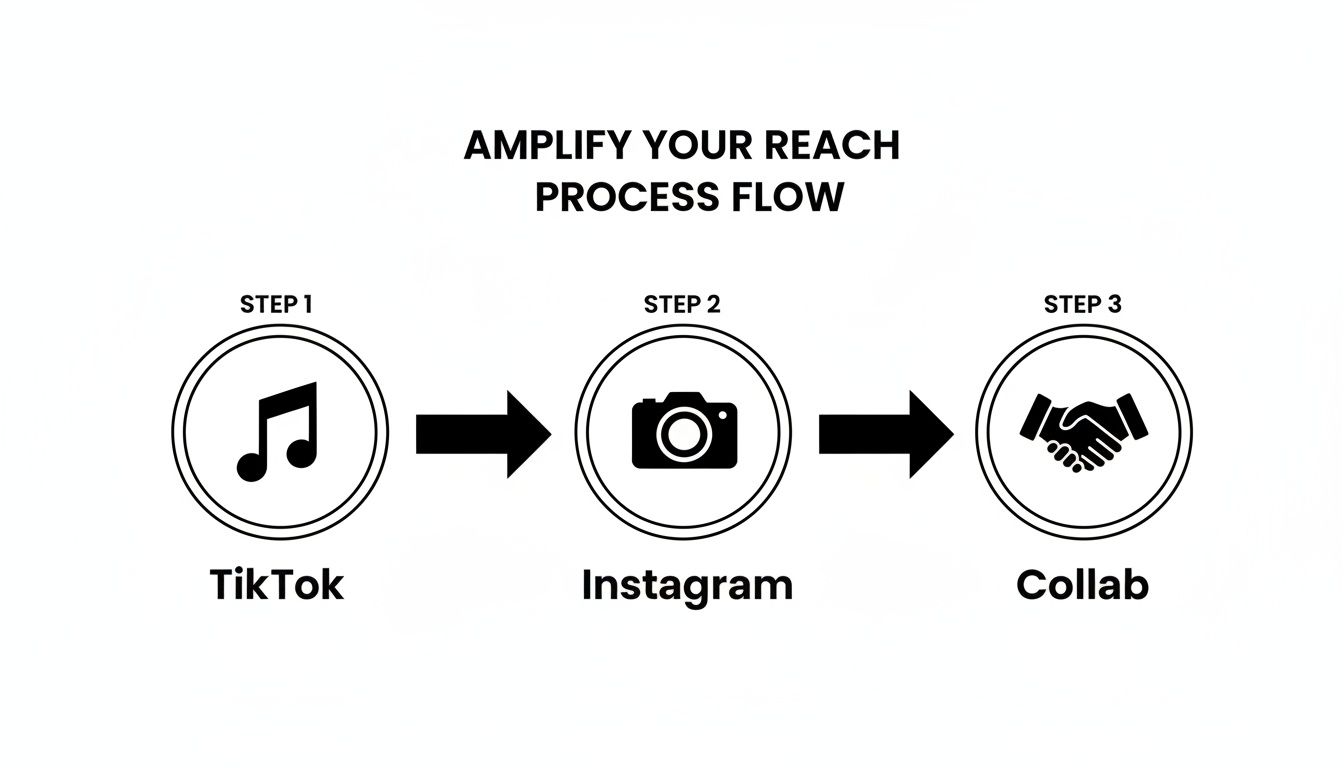
It’s essentially a funnel. You use short, snappy videos on places like TikTok and Instagram to grab attention, then channel that interest towards longer, more in-depth collaborative content on YouTube. That’s where the real subscriber growth happens.
Mastering Cross-Platform Promotion
Every social media platform has its own vibe, its own unwritten rules. Just dumping a raw YouTube link onto your Instagram feed and hoping for the best is a recipe for disappointment. The trick is to create native content for each platform that teases the value of your main video.
Instagram Reels & TikTok: These are goldmines for high-impact, vertical clips. Find the most exciting 15-30 second snippet from your YouTube video—the big reveal, a genuinely funny moment, or a shocking stat. Slap on some trending audio, add a bit of on-screen text, and finish with a crystal-clear call to action, like "Full breakdown in the link in my bio!"
X (formerly Twitter): This is where you start conversations. Pose a thought-provoking question related to your video's topic or share a key insight as a simple text post. Even better, you could write a short thread breaking down the main arguments, dropping a link to the full video at the end for anyone who wants to go deeper.
The goal here isn't just to spam your link. It's to provide genuine, standalone value on each platform while making it almost impossible for people not to click through to YouTube for the full story.
The Untapped Power of Collaborations
Teaming up with another creator in your niche is one of the single fastest ways to grow. It’s a powerful endorsement. You’re essentially being introduced to a whole new community of engaged viewers who are already primed to be interested in your sort of content.
Of course, finding the right partner is everything. Look for channels that are a similar size to yours. You want to share a target audience, but not be direct competitors. For example, if your channel is all about "budget PC builds," a perfect collaborator might be a creator who reviews "budget gaming monitors." It just makes sense.
When you reach out to pitch a collaboration, make it about them, not just about you. Don't just say, "Wanna collab?" Instead, propose a specific video idea that benefits you both. Frame it as, "I think our audiences would absolutely love to see us tackle X," showing you've actually put some thought into creating value for everyone involved.
Case Study: How Collaborations Fuelled Explosive Growth
Take a look at the journey of creator Shelby Church. Early on, she took part in a "collab week" with several other creators in her niche, like Monica Church and Mai Pham. They filmed a bunch of videos together, with each creator posting on their own channel while heavily promoting everyone else.
The impact was immediate. By tapping into each other’s established communities, they all saw a massive, simultaneous surge in subscribers. Shelby’s channel, for instance, rocketed from around 300,000 to over 500,000 subscribers in just a few months after these partnerships. This proves that a well-planned collaboration isn't just a fun side project; it's a serious growth engine that can put your channel in front of thousands of potential new subscribers almost overnight.
Building a System for Repeatable Success
Real, consistent growth isn't about getting lucky with one viral video. It’s about building a disciplined, repeatable process that you can follow every single time. Turning these strategies into second nature is how you create momentum that actually lasts.
Think of the following steps as your standard operating procedure for every video you create. Instead of wondering what to do next, you'll have a proven path that takes you from a raw idea all the way through to promotion. This structured approach takes the guesswork out of the equation and helps you consistently get more subs on YouTube.
Before You Hit Record: The Pre-Production Blueprint
This is where videos are won or lost. Honestly, getting this stage right is absolutely crucial. You don't want to pour hours into filming and editing a video that was doomed from the start.
- Validate Your Idea: First things first, is there actually an audience for this? Check search volumes and see what's trending in your niche. Your gut feelings are great, but hard data confirming people are looking for your topic is even better.
- Map It Out: What is the core promise you're making to the viewer? Sketch out a script or at least a detailed outline. You need a killer hook to grab them, clear talking points to deliver value, and a strong call to action at the end. A good plan stops you from rambling and keeps your audience hooked.
From Camera to Computer: Production & Post-Production
Once you have a solid idea and a tight script, it’s all about execution. Great production is about capturing clean, professional footage, and post-production is where you polish that raw material to maximise discovery and keep people watching.
- Focus on the Fundamentals: Make sure your audio is crystal clear and your lighting does the job. People are surprisingly forgiving of so-so video quality, but they will click away in a heartbeat if they can't hear you properly. Bad audio is the ultimate channel killer.
- Edit for Retention: Be ruthless. Cut out every single ounce of fluff. Use jump cuts, B-roll, or graphics to keep things visually interesting. The goal is to maintain a snappy pace that keeps the viewer engaged right to the very end.
- Optimise for Discovery: Before you publish, nail your SEO. Craft a title packed with relevant keywords, design a thumbnail that demands to be clicked, and write a detailed description. This is how you signal to the YouTube algorithm what your video is about and who it should show it to.
Case Study: Shawn Forno A repeatable system is your single greatest asset. Just look at Shawn Forno of the "Days We Spend" channel. He emphasises how his consistent, process-driven uploads were the key to growing his community to over 28,000 subscribers. It’s proof that a methodical approach really does build a loyal audience over time. He follows the same workflow—from ideation to promotion—for every video, ensuring quality and consistency.
Finally, once it's live, don't forget to promote it! Share customised clips on your other social media channels and make a point to engage with every single comment. That’s how you start building a real community, not just a view count.
To make this even easier, we've boiled down the entire process into a simple checklist. Follow this for every single video to make sure you're ticking all the boxes for growth.
The Ultimate Video Growth Checklist
| Phase | Action Item | Key Goal |
|---|---|---|
| Ideation & Research | Validate idea with search/trend data | Ensure audience demand exists |
| Pre-Production | Write a script/outline with a strong hook | Maximise viewer engagement from the start |
| Production | Record with clear audio and good lighting | Create a professional and watchable video |
| Post-Production | Edit ruthlessly to remove fluff | Improve audience retention and watch time |
| Optimisation | Craft SEO-focused title and description | Increase discoverability in search and suggestions |
| Optimisation | Design a high-contrast, clickable thumbnail | Boost click-through rate (CTR) |
| Launch | Add end screens and cards with a clear CTA | Convert viewers into subscribers |
| Post-Launch | Promote on other platforms (socials, email) | Drive initial traffic and momentum |
| Community | Engage with comments and feedback | Build a loyal, returning audience |
| Analysis | Review analytics after 7 days | Identify what worked and what didn't for next time |
By making this checklist a non-negotiable part of your workflow, you're not just creating content—you're building a reliable engine for channel growth.
Your Questions, Answered
Growing a YouTube channel always throws up a few tricky questions. I get asked these all the time, so let's clear up some of the most common hurdles you'll face on your journey to more subscribers.
How Long Does It Really Take to Hit 1,000 Subscribers?
This is the million-dollar question, isn't it? The honest answer is, it varies wildly. For a lot of creators putting in the work, you could be looking at anywhere from six months to a year, sometimes even longer.
But I've seen channels smash that milestone much faster. The ones that do usually have a smart mix of evergreen, searchable content and videos that tap into current trends. The real secret is sticking with it, publishing consistently, and paying close attention to what your analytics are telling you.
Are YouTube Shorts Worth My Time for Gaining Subscribers?
Absolutely, but you need a plan. Think of Shorts as your channel's hype man. The algorithm is brilliant at pushing them out to a huge, fresh audience that might never have found your long-form videos otherwise.
Here’s a solid approach: use Shorts to create bite-sized teasers or highlight reels for your main videos. It’s a low-risk way to introduce yourself. If someone loves your 60-second clip, they're far more likely to click through to your channel to see the full story and hit that subscribe button.
Case Study: Jake Fellman Animator Jake Fellman pulled in over 14 million subscribers in under a year, and Shorts were his superpower. He created snappy, viral animations with popular gaming characters, built a massive audience with vertical video, and then successfully guided many of them towards his bigger, long-form projects, proving the power of Shorts as a subscriber funnel.
Let's Be Honest: Does Buying Subscribers Actually Work?
In a word: no. It's one of the worst things you can do for your channel's health. You're not buying fans; you're buying bots or dead accounts that will never watch, like, or comment on your videos.
This sends a terrible signal to YouTube's algorithm. It sees your videos have subscribers but zero engagement, and concludes your content must be bad. As a result, it will stop showing your videos to anyone, killing your organic reach stone dead. Your goal is to build a real community, and that's something you simply can't buy.
Ready to stop guessing and start creating videos with real viral potential? Vidito uses AI to generate and validate dozens of video ideas based on real-time data from YouTube, Google Trends, and Reddit. Know which ideas will work before you film. Start generating winning video ideas today at https://vidito.ai.