How Many Views to Make Money on YouTube UK Guide
Let's get straight to the point: there's no fixed price for a YouTube view. The most common misconception is that you get paid just for people watching.
The reality is, you earn money from ads shown on your videos. This is why 1,000 views could net a UK creator anything from £1 to over £20. It all comes down to your content and who's watching it.
Unpacking Your Potential YouTube Earnings in the UK
Instead of asking, "how many views do I need?", the real question is about your RPM. This stands for Revenue Per Mille, which is just a fancy way of saying your earnings per 1,000 views. This is the figure that actually hits your bank account after YouTube takes its share.
Your RPM isn't set in stone; it can swing wildly based on a few key factors. The biggest one? Your niche.
A creator making videos on personal finance or software tutorials will almost always have a higher RPM than someone in the gaming or lifestyle space. Why? Because advertisers will pay top-dollar to get their products in front of an audience they know has specific interests and spending power.
A channel with 100,000 views in a high-value niche can easily earn more than a channel with 1,000,000 views in a lower-paying one. It's not about the quantity of your views, but the quality of your audience.
To put this into perspective, let's look at some real-world numbers for UK-based creators. The table below breaks down potential earnings across different RPM brackets, showing just how much your chosen niche impacts your income.
Estimated YouTube Earnings in the UK per 1,000 Views
This table shows potential earnings per 1,000 views based on different RPMs, common for various UK content niches.
| RPM (Revenue Per 1,000 Views) | Niche Examples (UK) | Earnings per 1,000 Views | Earnings per 100,000 Views | Earnings per 1,000,000 Views |
|---|---|---|---|---|
| £1.50 - £4.00 | Gaming, Vlogs, Pranks, General Entertainment | £1.50 - £4.00 | £150 - £400 | £1,500 - £4,000 |
| £5.00 - £9.00 | Cooking, Beauty, Fitness, DIY Crafts | £5.00 - £9.00 | £500 - £900 | £5,000 - £9,000 |
| £10.00 - £25.00+ | Personal Finance, Tech, Real Estate, Business | £10.00 - £25.00+ | £1,000 - £2,500+ | £10,000 - £25,000+ |
As you can see, the difference is massive. A million views on a gaming channel might bring in a few thousand pounds, while the same number of views in the finance niche could be a full-time salary. This is why choosing and understanding your niche is the first, most crucial step to building a profitable channel.
How to Qualify for the YouTube Partner Programme

Before a single penny of ad money can land in your bank account, you first have to get through the door. On YouTube, that door is the YouTube Partner Programme (YPP). Think of it as the official club for creators who are ready to earn. Joining the YPP is that first massive milestone, turning your creative outlet into a potential source of income.
Getting in isn't automatic, though. YouTube has a set of criteria you need to meet, and it’s all designed to prove one thing: that you’ve built a real, engaged audience that genuinely values what you create. It's less about fleeting viral hits and more about demonstrating consistent community building.
Thankfully, YouTube offers a couple of different routes to get there, acknowledging that creators find success with both traditional long-form videos and the fast-paced world of Shorts.
The Traditional Path for Long-Form Video
This is the classic route, the one most established creators took. It’s all about showing sustained viewership and building a solid subscriber base over time. To qualify this way, you need to hit two main targets within the last 12 months:
- 1,000 Subscribers: This is your proof of community. It shows YouTube that a thousand people have hit that button because they want to see more from you.
- 4,000 Public Watch Hours: This is where engagement really comes into play. It proves people aren’t just clicking on your videos—they’re sticking around to watch them.
It's really important to get what "public watch hours" means. Only the hours from videos you’ve set to public will count. Any time spent watching your private, unlisted, or now-deleted videos won't help you reach that 4,000-hour goal.
Your real focus here should be on making content so engaging that viewers can't help but watch all the way through. Strong audience retention is the secret sauce for racking up those watch hours faster than you'd think.
The Fast Track for Shorts Creators
With the absolute explosion of short-form video, YouTube wisely created an alternative path just for Shorts creators. If your channel's energy is poured into Shorts, this could be your quickest way into the YPP. The goals are slightly different:
- 1,000 Subscribers: This milestone is the same, no matter which path you take.
- 10 Million Valid Public Shorts Views: Here’s the big one. You need to hit this massive view count within the last 90 days.
The word "valid" is key. Views from the Shorts feed, your channel page, and search results are what you're after. Views from other sources, like embedded players on websites, might not count towards your 10 million target.
Hitting the numbers is a huge step, but it’s not the final one. You'll still need to formally apply to the YPP, set up a Google AdSense account to get paid, and wait for your channel to be reviewed. This final check is just to make sure all your content follows YouTube's monetisation policies and community guidelines—basically, that it’s original and advertiser-friendly.
For any aspiring creator, understanding these thresholds is fundamental. They shape your content strategy from day one. To recap, as of 2025, you need to hit either 1,000 subscribers and 4,000 public watch hours in the last year, or 1,000 subscribers and 10 million valid Shorts views in the last 90 days. Once you’re in, YouTube starts sharing ad revenue with you, which is the foundational income stream for most creators. You can learn more about YouTube's monetisation statistics to get a better sense of the landscape.
Understanding What Your YouTube Views Are Worth
Ever look at two creators with a million views each and wonder why one is making a fortune while the other is just getting by? It's not a secret. It all comes down to understanding what your views are really worth. This is where the business side of YouTube kicks in, and it centres on two little acronyms: CPM and RPM.
Getting your head around these is the key to figuring out how many views you actually need to make money. Lots of creators get fixated on CPM, but it’s RPM that tells you what you're actually taking home.
CPM vs RPM: The Restaurant Analogy
Let’s think of it like owning a restaurant. On your menu, a steak dinner is listed for £20. That’s your CPM (Cost Per Mille), which is Latin for 'cost per thousand'. It's the "sticker price" an advertiser agrees to pay YouTube to show their ad 1,000 times on videos like yours. It's the total ad spend before anyone takes a cut.
But as the restaurant owner, you don't pocket that full £20. You’ve got costs – the ingredients, your staff, the rent. What you're left with after all that is your profit. On YouTube, that profit is your RPM (Revenue Per Mille), or 'revenue per thousand views'.
RPM is the total money your channel earns per 1,000 views, calculated after YouTube has taken its 45% slice of the ad revenue. This is the number that actually shows up in your AdSense account and the truest measure of your earning power.
While CPM tells you how much advertisers value your audience, RPM tells you how much your views are worth to you. Always keep your eyes on the RPM.
The Levers That Control Your RPM
Your RPM isn't set in stone. It moves up and down based on a few powerful factors. Knowing what they are is crucial because they directly control how much money you make from the exact same number of views. A creator who understands these levers can earn a whole lot more than one who doesn't.
The three big ones are:
- Your Content Niche: What your videos are about is the single biggest factor.
- Your Audience's Location: Where your viewers are in the world matters—a lot.
- The Time of Year: Ad budgets are seasonal, and your earnings will follow suit.
Let's dig into why each of these can make such a massive difference to your channel's bank account.
Why a Finance Video Out-Earns a Gaming Vlog
The niche you choose dictates which advertisers are bidding for ad space on your videos. High-value niches attract companies with deep pockets, which drives up the CPM and, in turn, your RPM.
Put yourself in an advertiser's shoes. A company selling a £2,000 investment course is happy to pay a lot more to reach people interested in personal finance than a company selling a £5 mobile game. The potential return is just so much higher for them.
This is why a finance channel might see an RPM of £15-£25, while a gaming channel might be closer to £2-£4. For 100,000 views, the finance creator could pocket £2,000, while the gamer earns just £300. Same view count, vastly different outcome.
Practical Example: YouTuber Case Studies
You can see this playing out with real creators. Someone like Graham Stephan, who focuses on finance, has openly shared his analytics showing RPMs that can top $20 (£16). His content on credit cards and investing is a magnet for high-paying financial advertisers.
On the other hand, a commentary YouTuber like Jarvis Johnson covers broader pop culture topics. While his channel is wildly successful with millions of views, the value per thousand views will naturally be lower because the audience isn't as niche from a commercial standpoint.
This doesn't mean one niche is "better" than another, but it does reveal a critical truth: your topic choice is a financial decision. Using a tool like Vidito to research niche viability and keyword value before you even hit record can help you build a more profitable channel from day one.
The Value of a UK Viewer
Finally, where your audience is watching from plays a massive role. Advertisers pay a premium to reach viewers in affluent countries with strong consumer economies, like the UK, USA, Canada, and Australia. A view from someone in the UK can easily be worth 5 to 10 times more than a view from someone in a developing market.
It's simple economics: audiences in these regions have more disposable income and are more likely to buy the products being advertised. If your audience is mainly in a high-value country, your RPM will climb. That's why making content that specifically resonates with a UK audience can be a very smart, deliberate monetisation strategy.
How Your Niche and Audience Drive Your Income
Let's get one thing straight: not all views are created equal. While it's tempting to fixate on hitting big view count milestones, the real story of your earnings potential is written by who is watching and what they're watching. Your chosen niche, and the audience it attracts, are the biggest levers you can pull to increase your income on YouTube.
Think of it like this. An advertiser selling high-end investment software is willing to pay a lot more to get their ad in front of someone watching a "best UK stock market strategies for 2025" video. That viewer is a hot lead. The same advertiser isn't going to pay much to show that ad to someone watching a compilation of funny cat videos. That's the power of a targeted niche.
Ultimately, it’s all about the commercial value of your audience. Advertisers are constantly bidding for ad space on videos like yours. When your content speaks directly to people interested in high-value products or services, that bidding war gets fierce, and your RPM (the revenue you actually earn per thousand views) skyrockets. It's why a channel in a profitable niche can earn the same money from 100,000 views as a general entertainment channel might earn from 1,000,000 views.
Typical RPM Ranges by YouTube Niche in the UK
To bring this to life, let's look at how wildly different the earnings can be from one content category to another. Niches that cover topics with expensive products or services—think finance, tech, and business—will almost always have the highest RPMs because the advertisers have deep pockets and a lot to gain from each new customer.
Here’s a rough guide to what you might expect for a UK-based audience.
| Content Niche | Estimated UK RPM Range (£) | Why It's High/Low |
|---|---|---|
| Personal Finance & Investing | £12 - £25+ | This is the top tier. Advertisers are banks, investment platforms, and insurance firms, where a single new customer can be worth thousands. |
| Technology & Software Reviews | £8 - £20 | Brands selling pricey gadgets, software subscriptions, and online services are all competing for the attention of these viewers. |
| Beauty & Fashion | £4 - £9 | A very competitive space with lots of brands, but the average product price is much lower than in tech or finance, leading to lower ad bids. |
| Gaming & Entertainment | £1.50 - £5 | This niche often pulls in huge audiences, but those viewers are broad and the advertisers are usually promoting lower-cost items like mobile games or snacks. |
This table makes it crystal clear why there's no single answer to "how many views do you need to make money?". The journey to your first £1,000 could take 50,000 views in one niche or well over 500,000 in another. It's a strategic financial decision from day one. If you're just starting, it pays to learn how to find low competition keywords to carve out a profitable space for yourself.
The infographic below does a great job of showing how an advertiser's initial bid (the CPM) eventually becomes your take-home pay (the RPM) after YouTube takes its cut.
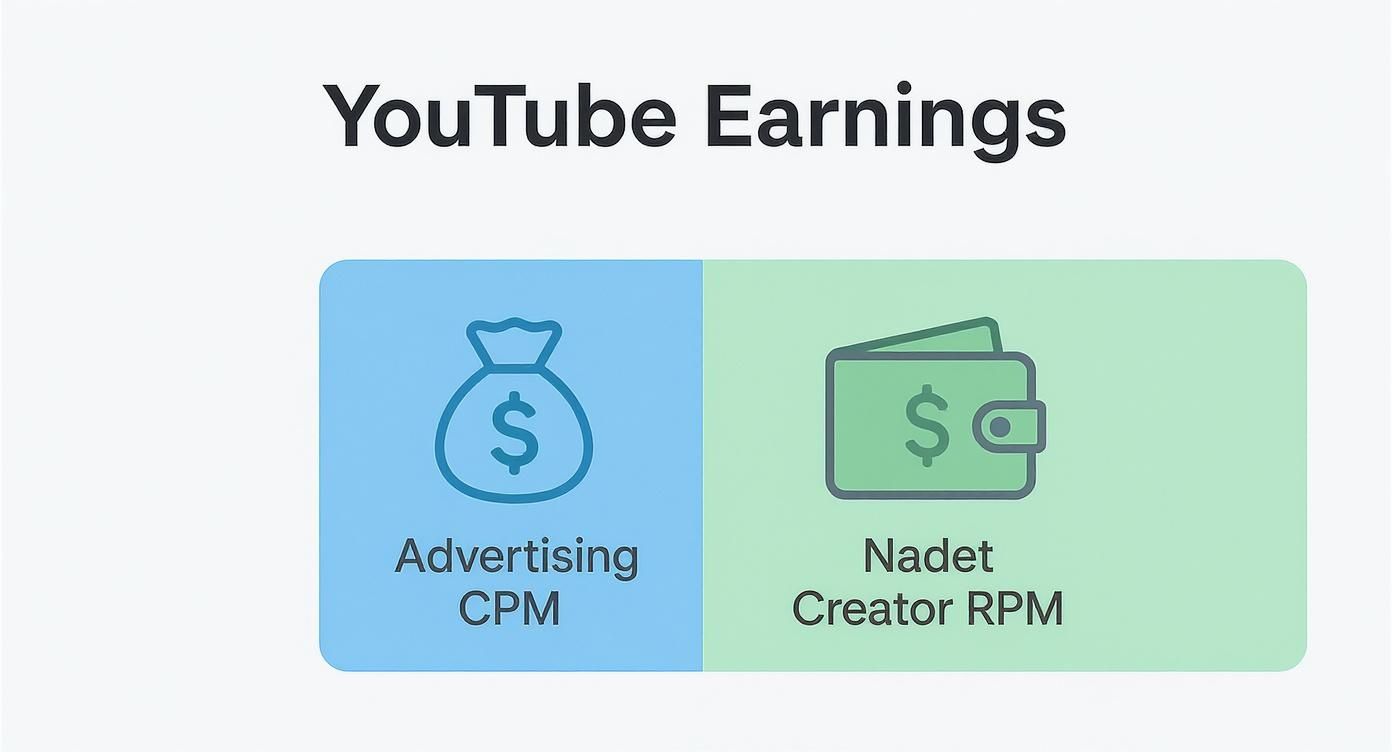
Just remember, your RPM is what actually lands in your bank account—it's the metric that truly matters.
A Tale of Two YouTubers
Let's make this even more concrete with a quick story about two UK creators. Both of them post a video that gets a respectable 100,000 views.
YouTuber 1: 'Financially Savvy Sarah'
- Niche: Personal Finance (investing in the UK)
- Audience: 25-45 year olds with disposable income, actively looking for ways to grow their wealth.
- Advertisers: Online brokerages, financial advisors, premium credit card companies.
- Typical RPM: A very healthy £18.
With her audience of high-value viewers, Sarah’s 100,000 views will earn her approximately £1,800. Not bad at all.
YouTuber 2: 'Gaming Guru Gary'
- Niche: Gaming (Let's Play videos)
- Audience: Mostly 13-24 year olds with little disposable income.
- Advertisers: Mobile games, energy drinks, fast-food chains.
- Typical RPM: A more modest £3.
Gary’s 100,000 views will bring in around £300.
That's a massive £1,500 difference in income from the exact same number of views. The lesson here is unavoidable: for maximising AdSense revenue, the quality of your audience, which is determined by your niche, is far more powerful than the raw quantity of your views.
Diversifying Your Income Beyond Ad Revenue
Relying purely on YouTube AdSense is a bit like building a house on a single pillar—it might hold up for a while, but it's a risky strategy. Ad revenue is notoriously fickle, swinging wildly based on the time of year or shifts in advertiser spending. The creators who truly build lasting success don't just have a channel; they build a business around their channel.
Smart creators quickly realise that their most valuable asset isn't just a big view count. It’s the community they’ve built, that loyal group of people who trust their recommendations and enjoy their content. By setting up multiple streams of income, you’re not just protecting yourself from a bad month on AdSense, you’re unlocking earning potential that can completely overshadow what ads alone could ever bring in.
The best part? Many of these alternative revenue sources can be set up long before you even qualify for the YouTube Partner Programme, giving you a serious head start on earning.
Fan Funding Your Creative Work
One of the most powerful ways to earn money is directly from the people who appreciate your work the most: your viewers. YouTube has leaned into this, creating tools that let your most dedicated fans support you financially.
These features, often called fan funding, let your audience give back in exchange for a little extra recognition or some exclusive perks. This builds a much stronger connection with your community and creates a stable income source that isn't tied to how many ads were shown on your latest video.
And it’s getting easier to access these tools. In the UK, YouTube recently lowered the bar, allowing creators to access fan funding with just 500 subscribers and three public uploads in the last 90 days. This means you can start building this income stream far earlier than you can with the traditional ad revenue model. You can learn more about these updated monetisation tiers on YouTube's official blog.
Here are the key fan funding tools at your disposal:
- Channel Memberships: Think of this as your own VIP club. Viewers pay a recurring monthly fee for exclusive badges, custom emojis, and members-only content.
- Super Chat & Super Thanks: During live streams or on your regular video uploads, viewers can pay to have their comments highlighted. It’s a great way for them to stand out and for you to earn a little extra.
These methods are brilliant because they reward you for building a tight-knit community, not just for chasing viral views. If you're curious about how this applies to different formats, our guide on YouTube Shorts monetisation is a great next read.
Entrepreneurial Income Streams
Stepping outside of YouTube's built-in tools is where things get really interesting. The most successful creators think like entrepreneurs, using their channel as the marketing engine for a much bigger operation. This is where your income can truly scale.
Affiliate Marketing is the classic first step. You simply recommend products you already use and love, and when someone buys through your unique link, you earn a commission. It’s a perfect match for review channels, how-to tutorials, and lifestyle content. For a detailed walkthrough, check out this guide on how to start affiliate marketing on YouTube.
Brand Sponsorships are the next level up. Once your channel has a bit of traction, brands will pay you a flat fee to feature their products or services in your videos. This provides a welcome injection of predictable income. Don't be shy about reaching out to brands you genuinely admire once you have a solid audience and the analytics to back it up.
Finally, the ultimate play for many is selling your own products. This could be anything from branded merchandise like t-shirts and mugs to digital products like e-books, online courses, or even software presets. You get the highest profit margins and maintain complete creative control—it’s your business, through and through.
Case Study: The Tech Reviewer Who Tripled His Income
Let's look at a real-world example. Imagine a UK creator, "Techie Tom," with around 50,000 subscribers. For his first year, he relied entirely on AdSense. He was making a respectable but inconsistent £800-£1,200 a month from his tech review videos. His RPM was good, but his income was still at the mercy of the YouTube algorithm.
Tom decided he needed to diversify. He started by adding Amazon affiliate links in his video descriptions for every single product he reviewed. That one small change immediately added an extra £500 to his monthly income.
Next, he put together a simple digital guide—"The Ultimate Beginner's Guide to Building a PC"—and sold it for £15. Because he’d built a trusting audience, he sold over 100 copies in the first month, bringing in another £1,500.
By combining AdSense, affiliate commissions, and his own digital product, Tom's monthly income shot up to over £3,000. He tripled his earnings without needing a single extra view. It just goes to show how a smart, diversified strategy can transform a channel from a hobby into a proper, sustainable business.
Actionable Strategies to Boost Your YouTube Earnings
https://www.youtube.com/embed/bASPxoSOlXo
Knowing the theory behind RPM and niches is a great start, but turning that knowledge into actual cash is what really matters. The good news? You don't need a sudden flood of millions of new viewers to see a real difference in your bank account. It’s all about making every single view you get work harder for you.
With a few smart adjustments to your content strategy, you can actively pump up your channel's earning potential. These aren't just abstract ideas; they're proven methods for boosting your RPM and creating new income streams, turning passive views into a reliable paycheque.
Optimise Your Video Length and Ad Placements
One of the most straightforward ways to make more from AdSense is to create videos that are longer than eight minutes. This is the magic threshold where YouTube lets you place mid-roll ads—extra ad breaks you can slot into the middle of your content, not just at the very beginning.
Think about it: more ad slots mean more chances to earn. A 12-minute video could easily have a pre-roll ad and a couple of mid-rolls, potentially tripling the ad revenue you'd get from a seven-minute video with only one ad. Just be mindful to place them at natural pauses in your content so you don't jolt your audience out of the experience.
Target High-Value Keywords and Topics
As we've discussed, your niche plays a massive role in your RPM. You can get even more strategic by zeroing in on specific, high-value keywords within that niche. Put yourself in an advertiser's shoes and think about what topics attract companies with deep pockets.
For instance, a video titled "My Budget Gaming PC Build" is going to attract a different level of advertiser than one called "Best Tax Software for UK Small Businesses". The second title is a direct signal to finance brands that their ideal customer is watching right now, and they'll pay a premium for that.
Here’s how you can unearth these golden topics:
- Analyse Competitors: See what videos are working for the top creators in your space. Which topics seem to consistently draw in premium advertisers?
- Use Keyword Tools: Tools can help you spot keywords that have high search volume and high commercial intent.
- Think Like an Advertiser: Ask yourself, "If I were a big-name brand, what kind of video would I want my ad to appear on?"
Building your content plan around these commercially valuable ideas is a deliberate move to increase what you earn from every view.
Increase Audience Retention and Watch Time
Audience retention—the average percentage of a video people actually watch—is a huge green flag for the YouTube algorithm. Videos that keep people glued to the screen get pushed out to more viewers, which is a fantastic way to learn how to get views on YouTube.
But great retention also has a direct line to your wallet. A longer watch time means viewers are more likely to see multiple ads, especially in those videos over eight minutes. More than that, it proves to advertisers that your channel is full of engaged viewers, making your ad space far more desirable.
A Real-World Example: YouTuber Vanessa Lau is a master of this. She creates deep-dive tutorials that can be 20-30 minutes long. Because her audience sticks around for the value she provides, she can strategically place several mid-roll ads, massively boosting the RPM for each video. Her channel proves that when the content is genuinely helpful, viewers don't mind the length, making longer formats incredibly profitable.
Expand Your Reach Globally
Why limit yourself to an English-speaking audience? While there are millions of English speakers, there are billions more who speak other languages. To truly scale your audience and your income, learning how to translate YouTube videos is a game-changer.
By adding subtitles or even dubbed audio tracks in languages like Spanish, Hindi, or German, you instantly unlock enormous new markets. This simple step can add thousands upon thousands of potential views to every single video you publish.
Frequently Asked Questions About YouTube Earnings
Right, let's clear up some of the questions that always come up when creators start thinking about making money on YouTube.
Do I Get Paid for Likes or Subscribers on YouTube?
The short answer is no, not directly. YouTube doesn't send you a cheque for hitting a certain number of likes or subscribers. Instead, think of them as key performance indicators for the YouTube algorithm.
When someone likes your video or subscribes to your channel, it's a powerful signal that your content is hitting the mark. This encourages the algorithm to push your videos out to a wider audience, which in turn leads to more views. More views mean more opportunities for ads to be shown, and that's where the money comes from. So, while a subscriber doesn't have a direct cash value, they are absolutely vital for growing the audience that generates your income.
How Much Does YouTube Take from My Earnings?
When it comes to ad revenue, YouTube is very upfront about the split. For standard, long-form videos, it's a 55/45 deal. You, as the creator, get to keep 55% of the net revenue from the ads on your videos, while YouTube takes the remaining 45%.
That 45% goes towards running the entire platform – everything from hosting the videos to the copyright management systems. For other monetisation features like Super Chats or Channel Memberships, the split can be different, but you'll always find a clear breakdown in your YouTube Studio analytics.
When and How Do I Actually Get Paid?
Getting paid by YouTube happens on a monthly cycle, and it’s all handled through your linked Google AdSense account. But first, you have to hit the payment threshold.
In the United Kingdom, that magic number is £60. Once your finalised earnings reach that amount and you've completed all the necessary verifications (identity, address, bank details), the payment is triggered. You can generally expect the money to land in your bank account sometime between the 21st and 26th of the following month.
Ready to stop guessing and start creating videos with real earning potential? Vidito uses AI to generate and validate viral video ideas based on real-time data, helping you discover profitable topics your audience will love. Start planning your next hit video today at Vidito.ai.