how to get subscribers on youtube - A UK Creator's Guide
Getting subscribers on YouTube isn't about some secret formula or algorithm hack. It boils down to a simple, powerful truth: create valuable content for a specific audience and publish it consistently. That's it.
Your job is to first figure out exactly who you're making videos for. Once you know that, every single video you create should be built from the ground up to serve them. Everything else—your titles, your thumbnails, your editing style—is just there to support that core mission.
Building Your Channel's Foundation
Before you even think about hitting that record button, you need to lay the groundwork. So many aspiring creators get this wrong. They jump straight into filming whatever feels fun that day, and they end up with a random assortment of videos that doesn't really appeal to anyone in particular.
A solid foundation isn't just picking a topic you like. It's about defining your channel's purpose and getting crystal clear on who your ideal viewer is.
This early strategic work is what separates channels that grow from those that stagnate. It ensures every video has a clear direction and speaks directly to the people most likely to hit subscribe and become genuine fans. If you're just starting out, it's worth taking the time to go through a proper guide on how to start a YouTube channel to make sure you've got all your bases covered. Think of it not just as making videos, but as building a real brand.
This whole process breaks down into three key stages: nailing your niche, creating a viewer persona, and then establishing your channel's unique identity.
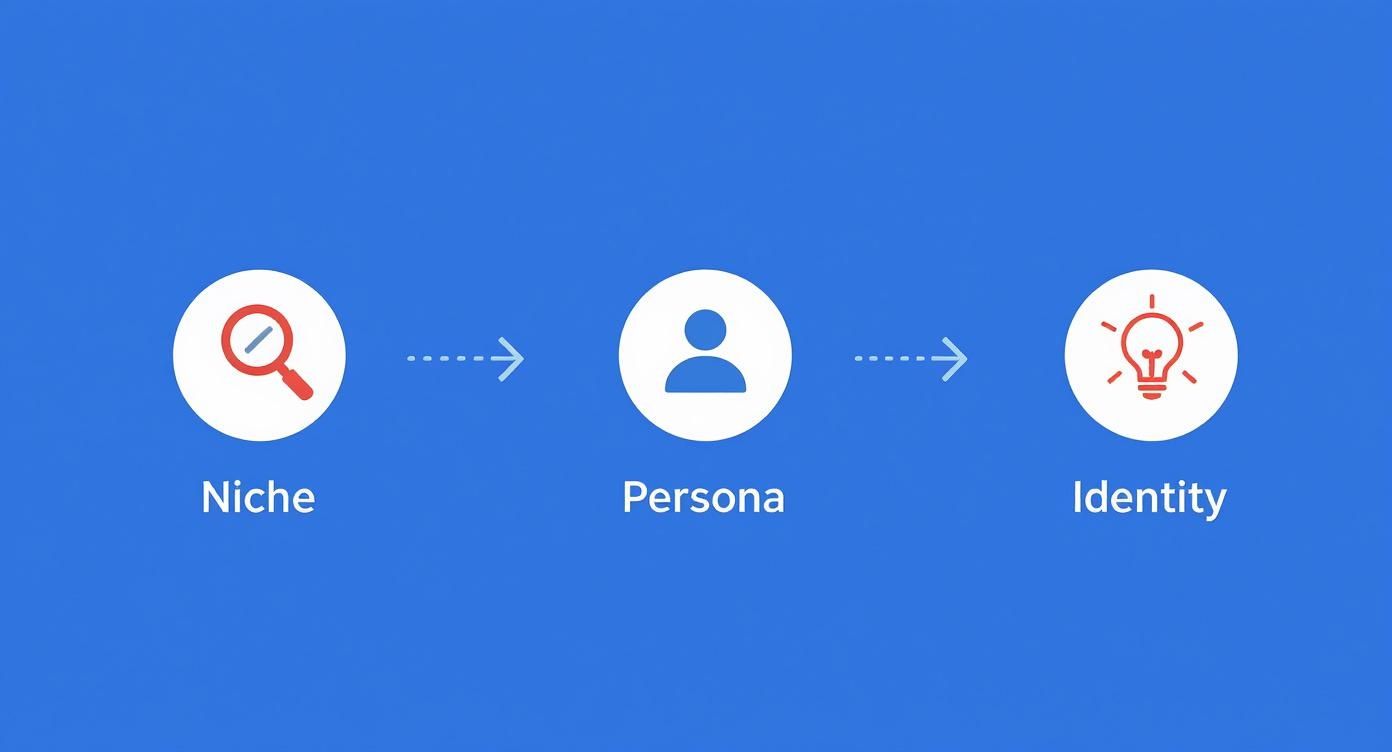
As you can see, you start broad by picking a niche, then you narrow your focus to a specific type of person, and that focus is what ultimately shapes the unique identity of your channel.
Define Your Niche and Audience
This is probably the most critical decision you'll make for your channel. A vague topic like "gaming" or "cooking" is a recipe for getting lost in the noise. It’s just too competitive. A truly successful niche drills down much deeper.
Instead of just "gaming," how about "sarcastic reviews of indie horror games on PC"? See the difference? That specificity immediately carves out a dedicated, underserved audience who are actively looking for that exact thing.
Case Study: 'Not Just Bikes'
This channel isn't just about 'cities'. It's specifically about 'why Dutch cities are so well-designed and why North American cities are not'. This hyper-specific niche has attracted millions of subscribers who are passionate about urban planning, creating a dedicated community that hangs on every video.
The goal isn't to appeal to everyone. It's to become the one, indispensable channel for a small, passionate group of people who feel like you're making content just for them.
Understanding the broader demographics helps, too. The UK YouTube landscape provides some useful clues for finding your audience.
UK YouTube Audience Snapshot
This table gives a quick overview of who's watching in the UK, which can help you spot opportunities and tailor your content.
| Metric | Statistic | Strategic Implication |
|---|---|---|
| Most Active Age Group | 25-44 years old (44% of users) | Content around careers, home ownership, family life, or sophisticated hobbies often performs well. |
| Second Largest Group | 18-24 years old (24% of users) | This group is highly engaged with trends, gaming, entertainment, and educational content that feels authentic. |
| Top Content Category | Music videos & "How-to" guides | There's a huge appetite for both entertainment and practical, problem-solving content. |
| Device Usage | ~70% on mobile devices | Your thumbnails, titles, and on-screen text must be clear and readable on a small screen. |
By aligning your niche with the platform's most engaged viewers, you're not fighting against the current; you're using it to your advantage.
Create a Detailed Viewer Persona
Once your niche is locked in, it’s time to build a persona for your ideal subscriber. Don't just think about demographics; picture a real, living person. Give them a name.
- What are their biggest frustrations or burning questions? Our indie horror game viewer might be fed up with buggy, overpriced AAA titles and is desperate to find hidden gems.
- What's their sense of humour? Is it dry and sarcastic? A bit goofy? This is what defines your channel's tone of voice.
- What other creators do they already watch? Looking at those channels gives you a great sense of the formats, editing styles, and video lengths that already resonate with them.
This persona becomes your North Star. Seriously. Before you write a single script, ask yourself: "Would 'Alex' find this entertaining, useful, or interesting?" If the answer is a hesitant "maybe," then it's time to go back to the drawing board.
This simple gut-check keeps you laser-focused on serving the audience you want to attract. When they feel like you truly get them, hitting that subscribe button becomes a no-brainer.
Creating Videos That Actually Earn Subscriptions
Once you've nailed down your niche and audience, every single video becomes a chance to win a new subscriber. A great video doesn’t just clock up views; it makes someone think, "I need to see more from this person." This means you have to build every piece of content with that conversion in mind.
It’s about crafting an experience. From the very first frame to your final sign-off, every element has to pull its weight to keep people watching and leave them wanting more.
Hook Them in the First Five Seconds
Those first few seconds are the most valuable real estate in your entire video. Viewers are ruthless – they decide almost instantly whether you’re worth their time. Your one job is to give them a rock-solid reason to stick around.
Take a look at a creator like Ali Abdaal, the UK-based productivity expert. He doesn’t waste a second on fluffy intros. His videos kick off with a bold claim, a provocative question, or a flash-forward to the incredible result he’s about to teach. He gets straight to the point.
Most powerful hooks fall into a few key camps:
- The Problem Hook: Hit them with a pain point they know all too well. "Are you tired of your house plants dying within a month? I'm going to show you three common mistakes you're probably making."
- The Promise Hook: Be explicit about what they'll get out of watching. "By the end of this video, you will have a complete financial plan for saving your first £10,000."
- The Curiosity Hook: Throw them a curveball they can't ignore. A travel vlogger might start with, "This is the most overrated tourist trap in London, and I'm about to show you why."
Mastering this opening is non-negotiable. It's the first step to improving your audience retention, a massive signal the YouTube algorithm pays very close attention to.
Pair Thumbnails and Titles for a One-Two Punch
Think of your thumbnail and title as a tag team. They have to work together. The thumbnail’s job is to grab attention and spark an emotion, while the title provides the context and seals the deal. A brilliant thumbnail makes a promise that the title then clarifies.
So many creators make the mistake of creating them separately. Don’t. Design them in tandem so they tell one cohesive, irresistible story.
A Quick Case Study: MrBeast
The king of YouTube thumbnails, MrBeast, understands this perfectly. Look at his video "I Survived 50 Hours In Antarctica".
- Thumbnail: A striking image of him, visibly freezing, with a simple red circle highlighting the "-52°C" temperature. It's high emotion and high stakes.
- Title: It states the incredible challenge simply and clearly.
The thumbnail grabs your eye with emotion, and the title gives you the context you need to click. They are a perfect one-two punch. For more on this, our guide on how to make viral videos has some great practical tips.
Craft a Call-to-Action People Actually Respond To
Let's be honest, the generic "like, comment, and subscribe" is dead. It’s wallpaper. Viewers have heard it a million times, and it gives them absolutely no reason to act. Your call-to-action (CTA) has to be specific, feel earned, and connect directly to the video they just enjoyed.
A strong CTA isn't a demand; it's an invitation. You’re inviting the viewer to join a journey, become part of a community, or keep learning about a topic they clearly care about.
Instead of just begging, frame your subscription request as a clear benefit to them.
- For a series: "If you want to follow my journey renovating this Victorian terrace, subscribe so you don't miss next week's kitchen reveal."
- For a tutorial channel: "I release a new video every Tuesday with tips to help you become a better photographer. Hit subscribe so you don't miss out."
- For a review channel: "My next video is a deep dive into the competitor's product. Subscribe now to see how it stacks up."
This simple shift changes everything. You’ve just spent the whole video proving your value, and now you’re offering them more of it. That’s how you turn a passive viewer into a loyal subscriber.
Get Found: A Practical Guide to YouTube SEO

You can pour your heart and soul into creating a brilliant video, but if your audience can't find it, that effort is wasted. This is where getting to grips with YouTube Search Engine Optimisation (SEO) becomes your secret weapon, turning casual searchers into loyal subscribers.
It's time to stop thinking of YouTube as just a video-sharing site. It's the second-biggest search engine on the planet. Every second, people are typing in questions, looking for solutions, or trying to learn something new. Your goal is to make sure your video is the answer that pops up.
This is especially true in the UK. In March 2024, YouTube pulled in a staggering 71.98% of all social media site visits in the country, making it the undisputed king. With such a massive, engaged audience actively looking for content, optimising your videos gives you a direct path to the people you want to reach.
Figuring Out What People Are Actually Searching For
Good YouTube SEO always starts with solid keyword research. You have to get inside the head of your ideal viewer and understand the exact words and phrases they’re using to find content like yours. If you just guess, you're creating videos for an audience of one.
One of the simplest, yet most effective, ways to do this is right in YouTube's search bar. Start typing a broad topic in your niche and watch what the autocomplete suggestions show you. These aren't random phrases; they are real searches from real people, giving you a direct look at what they're curious about.
For instance, if you run a UK gardening channel, typing "container gardening for beginners" might reveal:
- container gardening for beginners uk
- container gardening for beginners small spaces
- what to plant in containers for beginners uk
These aren't just ideas for videos. They are the exact titles you should be considering. Each one represents a specific need that you can fill with your content. To really dig in and find those hidden gems, check out this guide on how to find low-competition keywords for more advanced tactics.
Crafting Titles and Descriptions That Get Clicks
Once you've identified your target keywords, you need to weave them into your video's metadata—that's your title, description, and tags. This is the information you feed the YouTube algorithm, helping it understand what your video is about and who to show it to.
Your title is your most valuable piece of SEO real estate. It needs to grab a person's attention but also be crystal clear for the algorithm. That means including your main keyword while still sparking curiosity.
A great title makes a clear promise. A bad title is either vague or sounds like it was written for a robot. It's a delicate balance between being discoverable and being clickable.
Next up is the description. Don't just toss in a single sentence and call it a day. Write a detailed, two- or three-paragraph summary of what your video covers, making sure to naturally include your main and secondary keywords in the first few lines. This extra context is gold for the algorithm.
A Real-World Example: The UK Gardening Channel
Let's see how this works in practice. A new UK-based gardening channel uploads a video they initially call 'Beginner's Guide to Container Gardening'. To compete with bigger channels, they get smart with their SEO.
- Keyword-Optimised Title: They change the title to "Container Gardening for Beginners UK | 10 Easy Plants for Small Balconies". This immediately targets a specific, high-intent search term and adds a compelling benefit.
- Detailed Description: The first couple of lines of their description now read: "In this guide to container gardening for beginners in the UK, we show you how to start a beautiful garden in a small space like a balcony or patio. We'll cover the best soil mix for UK climates and more."
- Helpful Chapters: They add timestamps like "00:00 Intro", "01:15 Choosing the Right Pots", and "04:30 Best Soil Mix for UK Climates". Not only does this make the video easier to navigate, but it also gives the algorithm more specific keywords to latch onto.
By making these simple changes, their video starts showing up for those specific UK-based searches. They're no longer competing with every gardening channel in the world, but are instead attracting a highly targeted audience far more likely to subscribe. To really level up your strategy, explore these 10 YouTube SEO Best Practices.
Getting Your Videos Seen and Building a Community
https://www.youtube.com/embed/3NPieJutT9I
Hitting 'publish' on a perfectly polished video is a great feeling, but that’s really just the beginning. If you're serious about growing your subscriber count, you can't just sit back and wait for the algorithm to do all the work. The channels that truly take off are the ones that actively promote their content and build a genuine community around it.
Think of each video not as a final product, but as a conversation starter. Your mission is to take that conversation to other corners of the internet, inviting new people to join in. This creates momentum outside of YouTube and gives viewers multiple ways to find your channel.
Get More Mileage From Your Content
That long-form video you just spent hours on? It's a goldmine. You can slice it and dice it into bite-sized clips perfect for platforms like TikTok, Instagram Reels, and YouTube Shorts. These platforms are built for discovery and are fantastic for funnelling new viewers back to your main channel.
But don't just hack off a random clip. The trick is to isolate the most powerful, surprising, or valuable 60-second segment. Pull out that one "aha!" moment, a hilarious blooper, or a stunning visual that can stand on its own.
For instance, imagine a UK travel vlogger's 15-minute video on "A Weekend in the Cotswolds." That single video could easily become:
- A 15-second Reel of the most picturesque cottage they stumbled upon.
- A 30-second TikTok revealing the "best scone in Bourton-on-the-Water."
- A 60-second YouTube Short sharing one quick travel tip for the area.
Each of these short clips should wrap up with a simple, friendly nudge, like, "See the full trip in my new YouTube video – link in bio!" This strategy introduces your personality to a massive new audience that probably wouldn't have found you through a YouTube search.
Share Your Work (Without Being That Annoying Spammer)
Dropping your links in online communities can work wonders, but there’s a massive difference between being a helpful member and being an annoying self-promoter. The golden rule is simple: give value before you ask for anything.
Before you even think about posting your link in a UK-focused subreddit or Facebook Group, become part of the conversation. Look for a problem you can solve with your video.
Spammy: "Hey everyone, check out my new video!"
Valuable: Someone in a UK personal finance group asks, "I'm 25 and totally confused by ISAs." You can reply, "It's a common point of confusion! I actually made a detailed video explaining the difference between Cash and Stocks & Shares ISAs specifically for our age group. The first three minutes cover the exact question you're asking. Hope it helps!"
See the difference? This approach makes you look like a helpful expert, not a link-dropper. You're solving someone's problem, which makes them far more likely to check out your stuff and hit subscribe.
Team Up with Other Creators
Collaborations are a growth cheat code. They give you a direct line to an established, relevant audience that already trusts the creator you're working with. Look for other UK creators in a similar niche (but not a direct competitor) with a roughly similar subscriber count.
The project has to feel like a natural fit that benefits both of your audiences. A great example? A UK travel vlogger could team up with a UK food blogger. They could create a joint series like "Finding the Best Fish and Chips in Cornwall," where each person hosts a video on their channel and points their viewers to the other's video to see the rest of the adventure. It’s a classic win-win that introduces both channels to engaged viewers who are very likely to be interested.
Turn Viewers into True Fans
At the end of the day, getting subscribers is about more than just a number—it’s about building a loyal community. This is how you turn passive viewers into active fans who feel a real connection to you and your work.
It all starts in your comments section. Don't just 'heart' comments; reply to them. Ask follow-up questions, thank people for their ideas, and show you're listening. Use the Community Tab to post polls, ask questions, or share behind-the-scenes snaps. This keeps your audience engaged between uploads.
Case Study: LegalEagle
This creator, a real-life lawyer, breaks down legal scenes in movies and TV. After each video, he actively engages in the comments, answering legal questions and debating points with his viewers. He also uses the Community Tab to poll his audience on which movie he should review next, making them feel like part of the creative process. This transforms his channel from a simple broadcast into a thriving hub for discussion. To dig deeper, it’s worth exploring some powerful community engagement strategies.
Advanced Strategies for Sustained Growth

Once you've nailed the fundamentals, you hit the real challenge: keeping the momentum going. This is where you graduate from simply making videos to strategically building a channel. It’s all about getting under the skin of your data, truly understanding what makes your viewers tick, and building systems that let you create consistently brilliant content without burning out.
These are the strategies that separate the channels that plateau from the ones that achieve real, long-term growth. It's a shift in focus from how one video performs to the overall health of your entire content ecosystem.
Decode Your Audience Retention Graphs
Your YouTube Analytics dashboard is a goldmine, and the Audience Retention graph is the most precious bit of data in there. It shows you, second by second, the exact moments people are getting bored and clicking away. Learning to read this graph is like getting direct, unfiltered feedback from hundreds of your viewers.
You'll quickly start to spot a few common patterns:
- A huge initial drop: If you lose a massive chunk of your audience in the first 30 seconds, it’s a clear sign your hook isn't landing or your video isn’t delivering on the promise made by your title and thumbnail.
- A gradual decline: A steady, slow slope is perfectly normal. People have lives to lead, and not everyone is going to finish every single video you post.
- Sudden dips: These are the real clues. Pinpoint the exact second a dip occurs. Did you start a long, slow montage with no commentary? Did the audio suddenly get worse? Did you go off on an unrelated tangent?
- Spikes or bumps: These are golden. These are moments of high engagement where viewers are actually rewinding to re-watch a specific part. Whatever you did there, do more of it.
Start looking for patterns across multiple videos. If your viewers consistently bail every time you launch into your "favourite products of the week" segment, it’s probably time to rethink it or scrap it altogether. This data-driven approach is how you systematically improve your editing and scripting to keep people glued to the screen for longer.
Create a Binge-Watching Loop
The longer someone stays on YouTube watching your content, the more the algorithm is going to fall in love with your channel. The aim is to turn a single video view into a full-blown viewing session. That's how you dramatically increase the chances of earning a new subscriber.
Playlists are your best friend here. Don't just chuck all your uploads into one generic playlist. You need to organise your content logically into series or related topics that make sense to a viewer.
A Practical Playlist Example:
A UK cooking channel shouldn't just have one big "Recipes" playlist. It's far more effective to create specific, binge-worthy series like:
- 30-Minute Weeknight Dinners
- The Ultimate Sunday Roast Guide
- Classic British Baking
When someone finishes one video, YouTube is far more likely to auto-play the next video in that same, tightly-themed playlist. You're effectively keeping them locked into your channel.
End screens are the other half of this puzzle. In the final 10-20 seconds of your video, don't just sign off. Use your end screen elements to actively guide viewers to another one of your videos—ideally, one that’s a perfect follow-up to what they just watched.
Pro Tip: Don't just let YouTube pick a "Best for viewer" video for your end screen. Manually select a video that acts as the logical next step. If they just watched "How to Choose the Right Paint," your end screen should point directly to "My Top 5 Painting Techniques."
Beat Burnout with a Content Calendar
Consistency is probably the single most important factor for growing a channel. It shows your audience you're reliable, and it signals to the algorithm that your channel is active and worth promoting. But that relentless pressure to create can lead to burnout, which is the number one killer of promising YouTube channels.
The solution is to stop thinking week-to-week and start working in batches. This is where a proper content calendar becomes non-negotiable.
A Simple Batching Framework:
Let’s go back to that UK cooking channel. Imagine the next four videos are all part of the Sunday Roast series. Instead of a frantic scramble to film one video each week, you could batch the entire process:
- Day 1 (Planning): Script and prep for all four videos (Roast Chicken, Roast Beef, Perfect Roast Potatoes, Yorkshire Puddings). Get all the thinking done at once.
- Day 2 (Filming): Film all the "A-roll" (you talking to the camera) for all four videos back-to-back. Then, film all the "B-roll" (the close-up cooking shots) in one go.
- Days 3 & 4 (Editing): Now you can focus solely on editing the videos one by one.
By the end of the week, you have a full month's worth of content filmed and ready. This system completely removes that weekly "what am I going to post?" pressure, gives you vital creative breathing room, and ensures you never miss an upload. This is how you build a reliable schedule and get subscribers on YouTube who know they can count on you.
Your Top Questions Answered
Starting a YouTube channel can feel like you're staring at a mountain of questions. I get it. Over the years, I've seen countless creators in the UK grapple with the same uncertainties. Let's clear up some of the most common ones right now.
How Long Does It Realistically Take to Get 1,000 Subscribers?
This is the golden question, and the honest answer is: it's completely different for everyone. There's no set timetable. One creator might hit that milestone in a few dedicated months, while for another, it could take a year or more.
Think about it this way: a channel in a jam-packed niche like "London lifestyle vlogs" has a much steeper climb than one in a super-specific space, like "restoring vintage British motorcycles."
Your growth really boils down to your niche, how good your videos are, how consistently you post, and how well you get the word out. The best thing you can do is stop obsessing over the calendar and start focusing on the craft. Just try to make each video 1% better than the last. If you stick with the strategies in this guide, the subscribers will come.
Are 'Sub4Sub' Services a Good Idea?
In a word: no. Steer clear of these. Using "Sub for Sub" is one of the quickest ways to sabotage your own channel before it even gets going. You end up with a list of subscribers who couldn't care less about your content. They subscribed to get a sub back, and they will never watch your videos.
This absolutely tanks your channel's performance. Your watch time and audience retention will drop like a stone, which sends a massive red flag to the YouTube algorithm. YouTube will see that people aren't watching and will simply stop showing your videos to anyone new.
Always remember, it’s far better to have 100 genuine fans who can't wait for your next video than 1,000 ghost subscribers who never click play. Real, engaged viewers are the only way to build something that lasts.
Can YouTube Shorts Actually Help Me Get Subscribers?
Yes, absolutely. Shorts can be a fantastic way to get your channel in front of a massive new audience. A single viral Short can introduce you to thousands of people who might never have stumbled upon your longer videos otherwise.
The trick is to make sure your Shorts are directly connected to your main channel's theme. You want to build a bridge, not a dead end. This gives viewers a natural reason to move from your bite-sized content to your main videos.
Let's take a UK Personal Finance example:
Imagine a creator who makes videos about UK finance. They could post a 60-second Short on a "clever ISA tax trick." Anyone who finds that tip genuinely useful is a prime candidate to click through to the main channel for deeper dives on investing and saving. That's how you get high-quality, long-term subscribers from Shorts.
Do I Need to Spend a Fortune on Gear to Succeed?
Good quality matters, but that doesn't mean "expensive." The value you provide in your content will always, always be more important than how much your camera cost.
A modern smartphone can shoot brilliant 4K video. Pair that with a simple lavalier microphone, which you can pick up for around £20, and your audio will instantly sound ten times more professional than using your phone's built-in mic.
A fascinating, well-planned video shot on an iPhone will outperform a boring, rambling video shot on a cinema camera every single time. Pour your energy (and any initial budget) into the things that really move the needle:
- Great ideas that your ideal viewer actually cares about.
- Tight scripts that keep people watching from start to finish.
- Clean, clear audio. This is non-negotiable and often more crucial than video quality.
- Your own energy on camera. People connect with people.
You can always upgrade your kit later when the channel starts making some money. Don't let a lack of fancy gear become an excuse not to start.
Struggling to come up with video ideas that your audience will actually search for? Vidito uses AI to analyse trends and generate dozens of data-backed concepts tailored to your niche, so you can stop guessing and start creating content that gets views. Find your next viral video idea today at Vidito.ai.